{
  "version": "1",
  "pip_version": "24.0",
  "install": [
    {
      "download_info": {
        "url": "https://files.pythonhosted.org/packages/ef/27/39622993e8688a1f05898a3c3b2836b856f79c06637ebd4b71cb35cc9b18/numpy-2.0.1-cp311-cp311-manylinux_2_17_x86_64.manylinux2014_x86_64.whl",
        "archive_info": {
          "hash": "sha256=15eb4eca47d36ec3f78cde0a3a2ee24cf05ca7396ef808dda2c0ddad7c2bde67",
          "hashes": {
            "sha256": "15eb4eca47d36ec3f78cde0a3a2ee24cf05ca7396ef808dda2c0ddad7c2bde67"
          }
        }
      },
      "is_direct": false,
      "is_yanked": false,
      "requested": true,
      "metadata": {
        "metadata_version": "2.1",
        "name": "numpy",
        "version": "2.0.1",
        "summary": "Fundamental package for array computing in Python",
        "description": "<h1 align=\"center\">\n<img src=\"https://raw.githubusercontent.com/numpy/numpy/main/branding/logo/primary/numpylogo.svg\" width=\"300\">\n</h1><br>\n\n\n[![Powered by NumFOCUS](https://img.shields.io/badge/powered%20by-NumFOCUS-orange.svg?style=flat&colorA=E1523D&colorB=007D8A)](\nhttps://numfocus.org)\n[![PyPI Downloads](https://img.shields.io/pypi/dm/numpy.svg?label=PyPI%20downloads)](\nhttps://pypi.org/project/numpy/)\n[![Conda Downloads](https://img.shields.io/conda/dn/conda-forge/numpy.svg?label=Conda%20downloads)](\nhttps://anaconda.org/conda-forge/numpy)\n[![Stack Overflow](https://img.shields.io/badge/stackoverflow-Ask%20questions-blue.svg)](\nhttps://stackoverflow.com/questions/tagged/numpy)\n[![Nature Paper](https://img.shields.io/badge/DOI-10.1038%2Fs41586--020--2649--2-blue)](\nhttps://doi.org/10.1038/s41586-020-2649-2)\n[![OpenSSF Scorecard](https://api.securityscorecards.dev/projects/github.com/numpy/numpy/badge)](https://securityscorecards.dev/viewer/?uri=github.com/numpy/numpy)\n\n\nNumPy is the fundamental package for scientific computing with Python.\n\n- **Website:** https://www.numpy.org\n- **Documentation:** https://numpy.org/doc\n- **Mailing list:** https://mail.python.org/mailman/listinfo/numpy-discussion\n- **Source code:** https://github.com/numpy/numpy\n- **Contributing:** https://www.numpy.org/devdocs/dev/index.html\n- **Bug reports:** https://github.com/numpy/numpy/issues\n- **Report a security vulnerability:** https://tidelift.com/docs/security\n\nIt provides:\n\n- a powerful N-dimensional array object\n- sophisticated (broadcasting) functions\n- tools for integrating C/C++ and Fortran code\n- useful linear algebra, Fourier transform, and random number capabilities\n\nTesting:\n\nNumPy requires `pytest` and `hypothesis`.  Tests can then be run after installation with:\n\n    python -c \"import numpy, sys; sys.exit(numpy.test() is False)\"\n\nCode of Conduct\n----------------------\n\nNumPy is a community-driven open source project developed by a diverse group of\n[contributors](https://numpy.org/teams/). The NumPy leadership has made a strong\ncommitment to creating an open, inclusive, and positive community. Please read the\n[NumPy Code of Conduct](https://numpy.org/code-of-conduct/) for guidance on how to interact\nwith others in a way that makes our community thrive.\n\nCall for Contributions\n----------------------\n\nThe NumPy project welcomes your expertise and enthusiasm!\n\nSmall improvements or fixes are always appreciated. If you are considering larger contributions\nto the source code, please contact us through the [mailing\nlist](https://mail.python.org/mailman/listinfo/numpy-discussion) first.\n\nWriting code isn’t the only way to contribute to NumPy. You can also:\n- review pull requests\n- help us stay on top of new and old issues\n- develop tutorials, presentations, and other educational materials\n- maintain and improve [our website](https://github.com/numpy/numpy.org)\n- develop graphic design for our brand assets and promotional materials\n- translate website content\n- help with outreach and onboard new contributors\n- write grant proposals and help with other fundraising efforts\n\nFor more information about the ways you can contribute to NumPy, visit [our website](https://numpy.org/contribute/). \nIf you’re unsure where to start or how your skills fit in, reach out! You can\nask on the mailing list or here, on GitHub, by opening a new issue or leaving a\ncomment on a relevant issue that is already open.\n\nOur preferred channels of communication are all public, but if you’d like to\nspeak to us in private first, contact our community coordinators at\nnumpy-team@googlegroups.com or on Slack (write numpy-team@googlegroups.com for\nan invitation).\n\nWe also have a biweekly community call, details of which are announced on the\nmailing list. You are very welcome to join.\n\nIf you are new to contributing to open source, [this\nguide](https://opensource.guide/how-to-contribute/) helps explain why, what,\nand how to successfully get involved.\n",
        "description_content_type": "text/markdown",
        "home_page": "https://numpy.org",
        "author": "Travis E. Oliphant et al.",
        "maintainer_email": "NumPy Developers <numpy-discussion@python.org>",
        "license": "Copyright (c) 2005-2024, NumPy Developers.\nAll rights reserved.\n\nRedistribution and use in source and binary forms, with or without\nmodification, are permitted provided that the following conditions are\nmet:\n\n    * Redistributions of source code must retain the above copyright\n       notice, this list of conditions and the following disclaimer.\n\n    * Redistributions in binary form must reproduce the above\n       copyright notice, this list of conditions and the following\n       disclaimer in the documentation and/or other materials provided\n       with the distribution.\n\n    * Neither the name of the NumPy Developers nor the names of any\n       contributors may be used to endorse or promote products derived\n       from this software without specific prior written permission.\n\nTHIS SOFTWARE IS PROVIDED BY THE COPYRIGHT HOLDERS AND CONTRIBUTORS\n\"AS IS\" AND ANY EXPRESS OR IMPLIED WARRANTIES, INCLUDING, BUT NOT\nLIMITED TO, THE IMPLIED WARRANTIES OF MERCHANTABILITY AND FITNESS FOR\nA PARTICULAR PURPOSE ARE DISCLAIMED. IN NO EVENT SHALL THE COPYRIGHT\nOWNER OR CONTRIBUTORS BE LIABLE FOR ANY DIRECT, INDIRECT, INCIDENTAL,\nSPECIAL, EXEMPLARY, OR CONSEQUENTIAL DAMAGES (INCLUDING, BUT NOT\nLIMITED TO, PROCUREMENT OF SUBSTITUTE GOODS OR SERVICES; LOSS OF USE,\nDATA, OR PROFITS; OR BUSINESS INTERRUPTION) HOWEVER CAUSED AND ON ANY\nTHEORY OF LIABILITY, WHETHER IN CONTRACT, STRICT LIABILITY, OR TORT\n(INCLUDING NEGLIGENCE OR OTHERWISE) ARISING IN ANY WAY OUT OF THE USE\nOF THIS SOFTWARE, EVEN IF ADVISED OF THE POSSIBILITY OF SUCH DAMAGE.\n\n----\n\nThe NumPy repository and source distributions bundle several libraries that are\ncompatibly licensed.  We list these here.\n\nName: lapack-lite\nFiles: numpy/linalg/lapack_lite/*\nLicense: BSD-3-Clause\n  For details, see numpy/linalg/lapack_lite/LICENSE.txt\n\nName: dragon4\nFiles: numpy/_core/src/multiarray/dragon4.c\nLicense: MIT\n  For license text, see numpy/_core/src/multiarray/dragon4.c\n\nName: libdivide\nFiles: numpy/_core/include/numpy/libdivide/*\nLicense: Zlib\n  For license text, see numpy/_core/include/numpy/libdivide/LICENSE.txt\n\n\nNote that the following files are vendored in the repository and sdist but not\ninstalled in built numpy packages:\n\nName: Meson\nFiles: vendored-meson/meson/*\nLicense: Apache 2.0\n  For license text, see vendored-meson/meson/COPYING\n\nName: spin\nFiles: .spin/cmds.py\nLicense: BSD-3\n  For license text, see .spin/LICENSE\n\n----\n\nThis binary distribution of NumPy also bundles the following software:\n\n\nName: OpenBLAS\nFiles: numpy.libs/libopenblas*.so\nDescription: bundled as a dynamically linked library\nAvailability: https://github.com/OpenMathLib/OpenBLAS/\nLicense: BSD-3-Clause\n  Copyright (c) 2011-2014, The OpenBLAS Project\n  All rights reserved.\n\n  Redistribution and use in source and binary forms, with or without\n  modification, are permitted provided that the following conditions are\n  met:\n\n     1. Redistributions of source code must retain the above copyright\n        notice, this list of conditions and the following disclaimer.\n\n     2. Redistributions in binary form must reproduce the above copyright\n        notice, this list of conditions and the following disclaimer in\n        the documentation and/or other materials provided with the\n        distribution.\n     3. Neither the name of the OpenBLAS project nor the names of\n        its contributors may be used to endorse or promote products\n        derived from this software without specific prior written\n        permission.\n\n  THIS SOFTWARE IS PROVIDED BY THE COPYRIGHT HOLDERS AND CONTRIBUTORS \"AS IS\"\n  AND ANY EXPRESS OR IMPLIED WARRANTIES, INCLUDING, BUT NOT LIMITED TO, THE\n  IMPLIED WARRANTIES OF MERCHANTABILITY AND FITNESS FOR A PARTICULAR PURPOSE\n  ARE DISCLAIMED. IN NO EVENT SHALL THE COPYRIGHT OWNER OR CONTRIBUTORS BE\n  LIABLE FOR ANY DIRECT, INDIRECT, INCIDENTAL, SPECIAL, EXEMPLARY, OR CONSEQUENTIAL\n  DAMAGES (INCLUDING, BUT NOT LIMITED TO, PROCUREMENT OF SUBSTITUTE GOODS OR\n  SERVICES; LOSS OF USE, DATA, OR PROFITS; OR BUSINESS INTERRUPTION) HOWEVER\n  CAUSED AND ON ANY THEORY OF LIABILITY, WHETHER IN CONTRACT, STRICT LIABILITY,\n  OR TORT (INCLUDING NEGLIGENCE OR OTHERWISE) ARISING IN ANY WAY OUT OF THE\n  USE OF THIS SOFTWARE, EVEN IF ADVISED OF THE POSSIBILITY OF SUCH DAMAGE.\n\n\nName: LAPACK\nFiles: numpy.libs/libopenblas*.so\nDescription: bundled in OpenBLAS\nAvailability: https://github.com/OpenMathLib/OpenBLAS/\nLicense: BSD-3-Clause-Attribution\n  Copyright (c) 1992-2013 The University of Tennessee and The University\n                          of Tennessee Research Foundation.  All rights\n                          reserved.\n  Copyright (c) 2000-2013 The University of California Berkeley. All\n                          rights reserved.\n  Copyright (c) 2006-2013 The University of Colorado Denver.  All rights\n                          reserved.\n\n  $COPYRIGHT$\n\n  Additional copyrights may follow\n\n  $HEADER$\n\n  Redistribution and use in source and binary forms, with or without\n  modification, are permitted provided that the following conditions are\n  met:\n\n  - Redistributions of source code must retain the above copyright\n    notice, this list of conditions and the following disclaimer.\n\n  - Redistributions in binary form must reproduce the above copyright\n    notice, this list of conditions and the following disclaimer listed\n    in this license in the documentation and/or other materials\n    provided with the distribution.\n\n  - Neither the name of the copyright holders nor the names of its\n    contributors may be used to endorse or promote products derived from\n    this software without specific prior written permission.\n\n  The copyright holders provide no reassurances that the source code\n  provided does not infringe any patent, copyright, or any other\n  intellectual property rights of third parties.  The copyright holders\n  disclaim any liability to any recipient for claims brought against\n  recipient by any third party for infringement of that parties\n  intellectual property rights.\n\n  THIS SOFTWARE IS PROVIDED BY THE COPYRIGHT HOLDERS AND CONTRIBUTORS\n  \"AS IS\" AND ANY EXPRESS OR IMPLIED WARRANTIES, INCLUDING, BUT NOT\n  LIMITED TO, THE IMPLIED WARRANTIES OF MERCHANTABILITY AND FITNESS FOR\n  A PARTICULAR PURPOSE ARE DISCLAIMED. IN NO EVENT SHALL THE COPYRIGHT\n  OWNER OR CONTRIBUTORS BE LIABLE FOR ANY DIRECT, INDIRECT, INCIDENTAL,\n  SPECIAL, EXEMPLARY, OR CONSEQUENTIAL DAMAGES (INCLUDING, BUT NOT\n  LIMITED TO, PROCUREMENT OF SUBSTITUTE GOODS OR SERVICES; LOSS OF USE,\n  DATA, OR PROFITS; OR BUSINESS INTERRUPTION) HOWEVER CAUSED AND ON ANY\n  THEORY OF LIABILITY, WHETHER IN CONTRACT, STRICT LIABILITY, OR TORT\n  (INCLUDING NEGLIGENCE OR OTHERWISE) ARISING IN ANY WAY OUT OF THE USE\n  OF THIS SOFTWARE, EVEN IF ADVISED OF THE POSSIBILITY OF SUCH DAMAGE.\n\n\nName: GCC runtime library\nFiles: numpy.libs/libgfortran*.so\nDescription: dynamically linked to files compiled with gcc\nAvailability: https://gcc.gnu.org/git/?p=gcc.git;a=tree;f=libgfortran\nLicense: GPL-3.0-with-GCC-exception\n  Copyright (C) 2002-2017 Free Software Foundation, Inc.\n\n  Libgfortran is free software; you can redistribute it and/or modify\n  it under the terms of the GNU General Public License as published by\n  the Free Software Foundation; either version 3, or (at your option)\n  any later version.\n\n  Libgfortran is distributed in the hope that it will be useful,\n  but WITHOUT ANY WARRANTY; without even the implied warranty of\n  MERCHANTABILITY or FITNESS FOR A PARTICULAR PURPOSE.  See the\n  GNU General Public License for more details.\n\n  Under Section 7 of GPL version 3, you are granted additional\n  permissions described in the GCC Runtime Library Exception, version\n  3.1, as published by the Free Software Foundation.\n\n  You should have received a copy of the GNU General Public License and\n  a copy of the GCC Runtime Library Exception along with this program;\n  see the files COPYING3 and COPYING.RUNTIME respectively.  If not, see\n  <http://www.gnu.org/licenses/>.\n\n----\n\nFull text of license texts referred to above follows (that they are\nlisted below does not necessarily imply the conditions apply to the\npresent binary release):\n\n----\n\nGCC RUNTIME LIBRARY EXCEPTION\n\nVersion 3.1, 31 March 2009\n\nCopyright (C) 2009 Free Software Foundation, Inc. <http://fsf.org/>\n\nEveryone is permitted to copy and distribute verbatim copies of this\nlicense document, but changing it is not allowed.\n\nThis GCC Runtime Library Exception (\"Exception\") is an additional\npermission under section 7 of the GNU General Public License, version\n3 (\"GPLv3\"). It applies to a given file (the \"Runtime Library\") that\nbears a notice placed by the copyright holder of the file stating that\nthe file is governed by GPLv3 along with this Exception.\n\nWhen you use GCC to compile a program, GCC may combine portions of\ncertain GCC header files and runtime libraries with the compiled\nprogram. The purpose of this Exception is to allow compilation of\nnon-GPL (including proprietary) programs to use, in this way, the\nheader files and runtime libraries covered by this Exception.\n\n0. Definitions.\n\nA file is an \"Independent Module\" if it either requires the Runtime\nLibrary for execution after a Compilation Process, or makes use of an\ninterface provided by the Runtime Library, but is not otherwise based\non the Runtime Library.\n\n\"GCC\" means a version of the GNU Compiler Collection, with or without\nmodifications, governed by version 3 (or a specified later version) of\nthe GNU General Public License (GPL) with the option of using any\nsubsequent versions published by the FSF.\n\n\"GPL-compatible Software\" is software whose conditions of propagation,\nmodification and use would permit combination with GCC in accord with\nthe license of GCC.\n\n\"Target Code\" refers to output from any compiler for a real or virtual\ntarget processor architecture, in executable form or suitable for\ninput to an assembler, loader, linker and/or execution\nphase. Notwithstanding that, Target Code does not include data in any\nformat that is used as a compiler intermediate representation, or used\nfor producing a compiler intermediate representation.\n\nThe \"Compilation Process\" transforms code entirely represented in\nnon-intermediate languages designed for human-written code, and/or in\nJava Virtual Machine byte code, into Target Code. Thus, for example,\nuse of source code generators and preprocessors need not be considered\npart of the Compilation Process, since the Compilation Process can be\nunderstood as starting with the output of the generators or\npreprocessors.\n\nA Compilation Process is \"Eligible\" if it is done using GCC, alone or\nwith other GPL-compatible software, or if it is done without using any\nwork based on GCC. For example, using non-GPL-compatible Software to\noptimize any GCC intermediate representations would not qualify as an\nEligible Compilation Process.\n\n1. Grant of Additional Permission.\n\nYou have permission to propagate a work of Target Code formed by\ncombining the Runtime Library with Independent Modules, even if such\npropagation would otherwise violate the terms of GPLv3, provided that\nall Target Code was generated by Eligible Compilation Processes. You\nmay then convey such a combination under terms of your choice,\nconsistent with the licensing of the Independent Modules.\n\n2. No Weakening of GCC Copyleft.\n\nThe availability of this Exception does not imply any general\npresumption that third-party software is unaffected by the copyleft\nrequirements of the license of GCC.\n\n----\n\n                    GNU GENERAL PUBLIC LICENSE\n                       Version 3, 29 June 2007\n\n Copyright (C) 2007 Free Software Foundation, Inc. <http://fsf.org/>\n Everyone is permitted to copy and distribute verbatim copies\n of this license document, but changing it is not allowed.\n\n                            Preamble\n\n  The GNU General Public License is a free, copyleft license for\nsoftware and other kinds of works.\n\n  The licenses for most software and other practical works are designed\nto take away your freedom to share and change the works.  By contrast,\nthe GNU General Public License is intended to guarantee your freedom to\nshare and change all versions of a program--to make sure it remains free\nsoftware for all its users.  We, the Free Software Foundation, use the\nGNU General Public License for most of our software; it applies also to\nany other work released this way by its authors.  You can apply it to\nyour programs, too.\n\n  When we speak of free software, we are referring to freedom, not\nprice.  Our General Public Licenses are designed to make sure that you\nhave the freedom to distribute copies of free software (and charge for\nthem if you wish), that you receive source code or can get it if you\nwant it, that you can change the software or use pieces of it in new\nfree programs, and that you know you can do these things.\n\n  To protect your rights, we need to prevent others from denying you\nthese rights or asking you to surrender the rights.  Therefore, you have\ncertain responsibilities if you distribute copies of the software, or if\nyou modify it: responsibilities to respect the freedom of others.\n\n  For example, if you distribute copies of such a program, whether\ngratis or for a fee, you must pass on to the recipients the same\nfreedoms that you received.  You must make sure that they, too, receive\nor can get the source code.  And you must show them these terms so they\nknow their rights.\n\n  Developers that use the GNU GPL protect your rights with two steps:\n(1) assert copyright on the software, and (2) offer you this License\ngiving you legal permission to copy, distribute and/or modify it.\n\n  For the developers' and authors' protection, the GPL clearly explains\nthat there is no warranty for this free software.  For both users' and\nauthors' sake, the GPL requires that modified versions be marked as\nchanged, so that their problems will not be attributed erroneously to\nauthors of previous versions.\n\n  Some devices are designed to deny users access to install or run\nmodified versions of the software inside them, although the manufacturer\ncan do so.  This is fundamentally incompatible with the aim of\nprotecting users' freedom to change the software.  The systematic\npattern of such abuse occurs in the area of products for individuals to\nuse, which is precisely where it is most unacceptable.  Therefore, we\nhave designed this version of the GPL to prohibit the practice for those\nproducts.  If such problems arise substantially in other domains, we\nstand ready to extend this provision to those domains in future versions\nof the GPL, as needed to protect the freedom of users.\n\n  Finally, every program is threatened constantly by software patents.\nStates should not allow patents to restrict development and use of\nsoftware on general-purpose computers, but in those that do, we wish to\navoid the special danger that patents applied to a free program could\nmake it effectively proprietary.  To prevent this, the GPL assures that\npatents cannot be used to render the program non-free.\n\n  The precise terms and conditions for copying, distribution and\nmodification follow.\n\n                       TERMS AND CONDITIONS\n\n  0. Definitions.\n\n  \"This License\" refers to version 3 of the GNU General Public License.\n\n  \"Copyright\" also means copyright-like laws that apply to other kinds of\nworks, such as semiconductor masks.\n\n  \"The Program\" refers to any copyrightable work licensed under this\nLicense.  Each licensee is addressed as \"you\".  \"Licensees\" and\n\"recipients\" may be individuals or organizations.\n\n  To \"modify\" a work means to copy from or adapt all or part of the work\nin a fashion requiring copyright permission, other than the making of an\nexact copy.  The resulting work is called a \"modified version\" of the\nearlier work or a work \"based on\" the earlier work.\n\n  A \"covered work\" means either the unmodified Program or a work based\non the Program.\n\n  To \"propagate\" a work means to do anything with it that, without\npermission, would make you directly or secondarily liable for\ninfringement under applicable copyright law, except executing it on a\ncomputer or modifying a private copy.  Propagation includes copying,\ndistribution (with or without modification), making available to the\npublic, and in some countries other activities as well.\n\n  To \"convey\" a work means any kind of propagation that enables other\nparties to make or receive copies.  Mere interaction with a user through\na computer network, with no transfer of a copy, is not conveying.\n\n  An interactive user interface displays \"Appropriate Legal Notices\"\nto the extent that it includes a convenient and prominently visible\nfeature that (1) displays an appropriate copyright notice, and (2)\ntells the user that there is no warranty for the work (except to the\nextent that warranties are provided), that licensees may convey the\nwork under this License, and how to view a copy of this License.  If\nthe interface presents a list of user commands or options, such as a\nmenu, a prominent item in the list meets this criterion.\n\n  1. Source Code.\n\n  The \"source code\" for a work means the preferred form of the work\nfor making modifications to it.  \"Object code\" means any non-source\nform of a work.\n\n  A \"Standard Interface\" means an interface that either is an official\nstandard defined by a recognized standards body, or, in the case of\ninterfaces specified for a particular programming language, one that\nis widely used among developers working in that language.\n\n  The \"System Libraries\" of an executable work include anything, other\nthan the work as a whole, that (a) is included in the normal form of\npackaging a Major Component, but which is not part of that Major\nComponent, and (b) serves only to enable use of the work with that\nMajor Component, or to implement a Standard Interface for which an\nimplementation is available to the public in source code form.  A\n\"Major Component\", in this context, means a major essential component\n(kernel, window system, and so on) of the specific operating system\n(if any) on which the executable work runs, or a compiler used to\nproduce the work, or an object code interpreter used to run it.\n\n  The \"Corresponding Source\" for a work in object code form means all\nthe source code needed to generate, install, and (for an executable\nwork) run the object code and to modify the work, including scripts to\ncontrol those activities.  However, it does not include the work's\nSystem Libraries, or general-purpose tools or generally available free\nprograms which are used unmodified in performing those activities but\nwhich are not part of the work.  For example, Corresponding Source\nincludes interface definition files associated with source files for\nthe work, and the source code for shared libraries and dynamically\nlinked subprograms that the work is specifically designed to require,\nsuch as by intimate data communication or control flow between those\nsubprograms and other parts of the work.\n\n  The Corresponding Source need not include anything that users\ncan regenerate automatically from other parts of the Corresponding\nSource.\n\n  The Corresponding Source for a work in source code form is that\nsame work.\n\n  2. Basic Permissions.\n\n  All rights granted under this License are granted for the term of\ncopyright on the Program, and are irrevocable provided the stated\nconditions are met.  This License explicitly affirms your unlimited\npermission to run the unmodified Program.  The output from running a\ncovered work is covered by this License only if the output, given its\ncontent, constitutes a covered work.  This License acknowledges your\nrights of fair use or other equivalent, as provided by copyright law.\n\n  You may make, run and propagate covered works that you do not\nconvey, without conditions so long as your license otherwise remains\nin force.  You may convey covered works to others for the sole purpose\nof having them make modifications exclusively for you, or provide you\nwith facilities for running those works, provided that you comply with\nthe terms of this License in conveying all material for which you do\nnot control copyright.  Those thus making or running the covered works\nfor you must do so exclusively on your behalf, under your direction\nand control, on terms that prohibit them from making any copies of\nyour copyrighted material outside their relationship with you.\n\n  Conveying under any other circumstances is permitted solely under\nthe conditions stated below.  Sublicensing is not allowed; section 10\nmakes it unnecessary.\n\n  3. Protecting Users' Legal Rights From Anti-Circumvention Law.\n\n  No covered work shall be deemed part of an effective technological\nmeasure under any applicable law fulfilling obligations under article\n11 of the WIPO copyright treaty adopted on 20 December 1996, or\nsimilar laws prohibiting or restricting circumvention of such\nmeasures.\n\n  When you convey a covered work, you waive any legal power to forbid\ncircumvention of technological measures to the extent such circumvention\nis effected by exercising rights under this License with respect to\nthe covered work, and you disclaim any intention to limit operation or\nmodification of the work as a means of enforcing, against the work's\nusers, your or third parties' legal rights to forbid circumvention of\ntechnological measures.\n\n  4. Conveying Verbatim Copies.\n\n  You may convey verbatim copies of the Program's source code as you\nreceive it, in any medium, provided that you conspicuously and\nappropriately publish on each copy an appropriate copyright notice;\nkeep intact all notices stating that this License and any\nnon-permissive terms added in accord with section 7 apply to the code;\nkeep intact all notices of the absence of any warranty; and give all\nrecipients a copy of this License along with the Program.\n\n  You may charge any price or no price for each copy that you convey,\nand you may offer support or warranty protection for a fee.\n\n  5. Conveying Modified Source Versions.\n\n  You may convey a work based on the Program, or the modifications to\nproduce it from the Program, in the form of source code under the\nterms of section 4, provided that you also meet all of these conditions:\n\n    a) The work must carry prominent notices stating that you modified\n    it, and giving a relevant date.\n\n    b) The work must carry prominent notices stating that it is\n    released under this License and any conditions added under section\n    7.  This requirement modifies the requirement in section 4 to\n    \"keep intact all notices\".\n\n    c) You must license the entire work, as a whole, under this\n    License to anyone who comes into possession of a copy.  This\n    License will therefore apply, along with any applicable section 7\n    additional terms, to the whole of the work, and all its parts,\n    regardless of how they are packaged.  This License gives no\n    permission to license the work in any other way, but it does not\n    invalidate such permission if you have separately received it.\n\n    d) If the work has interactive user interfaces, each must display\n    Appropriate Legal Notices; however, if the Program has interactive\n    interfaces that do not display Appropriate Legal Notices, your\n    work need not make them do so.\n\n  A compilation of a covered work with other separate and independent\nworks, which are not by their nature extensions of the covered work,\nand which are not combined with it such as to form a larger program,\nin or on a volume of a storage or distribution medium, is called an\n\"aggregate\" if the compilation and its resulting copyright are not\nused to limit the access or legal rights of the compilation's users\nbeyond what the individual works permit.  Inclusion of a covered work\nin an aggregate does not cause this License to apply to the other\nparts of the aggregate.\n\n  6. Conveying Non-Source Forms.\n\n  You may convey a covered work in object code form under the terms\nof sections 4 and 5, provided that you also convey the\nmachine-readable Corresponding Source under the terms of this License,\nin one of these ways:\n\n    a) Convey the object code in, or embodied in, a physical product\n    (including a physical distribution medium), accompanied by the\n    Corresponding Source fixed on a durable physical medium\n    customarily used for software interchange.\n\n    b) Convey the object code in, or embodied in, a physical product\n    (including a physical distribution medium), accompanied by a\n    written offer, valid for at least three years and valid for as\n    long as you offer spare parts or customer support for that product\n    model, to give anyone who possesses the object code either (1) a\n    copy of the Corresponding Source for all the software in the\n    product that is covered by this License, on a durable physical\n    medium customarily used for software interchange, for a price no\n    more than your reasonable cost of physically performing this\n    conveying of source, or (2) access to copy the\n    Corresponding Source from a network server at no charge.\n\n    c) Convey individual copies of the object code with a copy of the\n    written offer to provide the Corresponding Source.  This\n    alternative is allowed only occasionally and noncommercially, and\n    only if you received the object code with such an offer, in accord\n    with subsection 6b.\n\n    d) Convey the object code by offering access from a designated\n    place (gratis or for a charge), and offer equivalent access to the\n    Corresponding Source in the same way through the same place at no\n    further charge.  You need not require recipients to copy the\n    Corresponding Source along with the object code.  If the place to\n    copy the object code is a network server, the Corresponding Source\n    may be on a different server (operated by you or a third party)\n    that supports equivalent copying facilities, provided you maintain\n    clear directions next to the object code saying where to find the\n    Corresponding Source.  Regardless of what server hosts the\n    Corresponding Source, you remain obligated to ensure that it is\n    available for as long as needed to satisfy these requirements.\n\n    e) Convey the object code using peer-to-peer transmission, provided\n    you inform other peers where the object code and Corresponding\n    Source of the work are being offered to the general public at no\n    charge under subsection 6d.\n\n  A separable portion of the object code, whose source code is excluded\nfrom the Corresponding Source as a System Library, need not be\nincluded in conveying the object code work.\n\n  A \"User Product\" is either (1) a \"consumer product\", which means any\ntangible personal property which is normally used for personal, family,\nor household purposes, or (2) anything designed or sold for incorporation\ninto a dwelling.  In determining whether a product is a consumer product,\ndoubtful cases shall be resolved in favor of coverage.  For a particular\nproduct received by a particular user, \"normally used\" refers to a\ntypical or common use of that class of product, regardless of the status\nof the particular user or of the way in which the particular user\nactually uses, or expects or is expected to use, the product.  A product\nis a consumer product regardless of whether the product has substantial\ncommercial, industrial or non-consumer uses, unless such uses represent\nthe only significant mode of use of the product.\n\n  \"Installation Information\" for a User Product means any methods,\nprocedures, authorization keys, or other information required to install\nand execute modified versions of a covered work in that User Product from\na modified version of its Corresponding Source.  The information must\nsuffice to ensure that the continued functioning of the modified object\ncode is in no case prevented or interfered with solely because\nmodification has been made.\n\n  If you convey an object code work under this section in, or with, or\nspecifically for use in, a User Product, and the conveying occurs as\npart of a transaction in which the right of possession and use of the\nUser Product is transferred to the recipient in perpetuity or for a\nfixed term (regardless of how the transaction is characterized), the\nCorresponding Source conveyed under this section must be accompanied\nby the Installation Information.  But this requirement does not apply\nif neither you nor any third party retains the ability to install\nmodified object code on the User Product (for example, the work has\nbeen installed in ROM).\n\n  The requirement to provide Installation Information does not include a\nrequirement to continue to provide support service, warranty, or updates\nfor a work that has been modified or installed by the recipient, or for\nthe User Product in which it has been modified or installed.  Access to a\nnetwork may be denied when the modification itself materially and\nadversely affects the operation of the network or violates the rules and\nprotocols for communication across the network.\n\n  Corresponding Source conveyed, and Installation Information provided,\nin accord with this section must be in a format that is publicly\ndocumented (and with an implementation available to the public in\nsource code form), and must require no special password or key for\nunpacking, reading or copying.\n\n  7. Additional Terms.\n\n  \"Additional permissions\" are terms that supplement the terms of this\nLicense by making exceptions from one or more of its conditions.\nAdditional permissions that are applicable to the entire Program shall\nbe treated as though they were included in this License, to the extent\nthat they are valid under applicable law.  If additional permissions\napply only to part of the Program, that part may be used separately\nunder those permissions, but the entire Program remains governed by\nthis License without regard to the additional permissions.\n\n  When you convey a copy of a covered work, you may at your option\nremove any additional permissions from that copy, or from any part of\nit.  (Additional permissions may be written to require their own\nremoval in certain cases when you modify the work.)  You may place\nadditional permissions on material, added by you to a covered work,\nfor which you have or can give appropriate copyright permission.\n\n  Notwithstanding any other provision of this License, for material you\nadd to a covered work, you may (if authorized by the copyright holders of\nthat material) supplement the terms of this License with terms:\n\n    a) Disclaiming warranty or limiting liability differently from the\n    terms of sections 15 and 16 of this License; or\n\n    b) Requiring preservation of specified reasonable legal notices or\n    author attributions in that material or in the Appropriate Legal\n    Notices displayed by works containing it; or\n\n    c) Prohibiting misrepresentation of the origin of that material, or\n    requiring that modified versions of such material be marked in\n    reasonable ways as different from the original version; or\n\n    d) Limiting the use for publicity purposes of names of licensors or\n    authors of the material; or\n\n    e) Declining to grant rights under trademark law for use of some\n    trade names, trademarks, or service marks; or\n\n    f) Requiring indemnification of licensors and authors of that\n    material by anyone who conveys the material (or modified versions of\n    it) with contractual assumptions of liability to the recipient, for\n    any liability that these contractual assumptions directly impose on\n    those licensors and authors.\n\n  All other non-permissive additional terms are considered \"further\nrestrictions\" within the meaning of section 10.  If the Program as you\nreceived it, or any part of it, contains a notice stating that it is\ngoverned by this License along with a term that is a further\nrestriction, you may remove that term.  If a license document contains\na further restriction but permits relicensing or conveying under this\nLicense, you may add to a covered work material governed by the terms\nof that license document, provided that the further restriction does\nnot survive such relicensing or conveying.\n\n  If you add terms to a covered work in accord with this section, you\nmust place, in the relevant source files, a statement of the\nadditional terms that apply to those files, or a notice indicating\nwhere to find the applicable terms.\n\n  Additional terms, permissive or non-permissive, may be stated in the\nform of a separately written license, or stated as exceptions;\nthe above requirements apply either way.\n\n  8. Termination.\n\n  You may not propagate or modify a covered work except as expressly\nprovided under this License.  Any attempt otherwise to propagate or\nmodify it is void, and will automatically terminate your rights under\nthis License (including any patent licenses granted under the third\nparagraph of section 11).\n\n  However, if you cease all violation of this License, then your\nlicense from a particular copyright holder is reinstated (a)\nprovisionally, unless and until the copyright holder explicitly and\nfinally terminates your license, and (b) permanently, if the copyright\nholder fails to notify you of the violation by some reasonable means\nprior to 60 days after the cessation.\n\n  Moreover, your license from a particular copyright holder is\nreinstated permanently if the copyright holder notifies you of the\nviolation by some reasonable means, this is the first time you have\nreceived notice of violation of this License (for any work) from that\ncopyright holder, and you cure the violation prior to 30 days after\nyour receipt of the notice.\n\n  Termination of your rights under this section does not terminate the\nlicenses of parties who have received copies or rights from you under\nthis License.  If your rights have been terminated and not permanently\nreinstated, you do not qualify to receive new licenses for the same\nmaterial under section 10.\n\n  9. Acceptance Not Required for Having Copies.\n\n  You are not required to accept this License in order to receive or\nrun a copy of the Program.  Ancillary propagation of a covered work\noccurring solely as a consequence of using peer-to-peer transmission\nto receive a copy likewise does not require acceptance.  However,\nnothing other than this License grants you permission to propagate or\nmodify any covered work.  These actions infringe copyright if you do\nnot accept this License.  Therefore, by modifying or propagating a\ncovered work, you indicate your acceptance of this License to do so.\n\n  10. Automatic Licensing of Downstream Recipients.\n\n  Each time you convey a covered work, the recipient automatically\nreceives a license from the original licensors, to run, modify and\npropagate that work, subject to this License.  You are not responsible\nfor enforcing compliance by third parties with this License.\n\n  An \"entity transaction\" is a transaction transferring control of an\norganization, or substantially all assets of one, or subdividing an\norganization, or merging organizations.  If propagation of a covered\nwork results from an entity transaction, each party to that\ntransaction who receives a copy of the work also receives whatever\nlicenses to the work the party's predecessor in interest had or could\ngive under the previous paragraph, plus a right to possession of the\nCorresponding Source of the work from the predecessor in interest, if\nthe predecessor has it or can get it with reasonable efforts.\n\n  You may not impose any further restrictions on the exercise of the\nrights granted or affirmed under this License.  For example, you may\nnot impose a license fee, royalty, or other charge for exercise of\nrights granted under this License, and you may not initiate litigation\n(including a cross-claim or counterclaim in a lawsuit) alleging that\nany patent claim is infringed by making, using, selling, offering for\nsale, or importing the Program or any portion of it.\n\n  11. Patents.\n\n  A \"contributor\" is a copyright holder who authorizes use under this\nLicense of the Program or a work on which the Program is based.  The\nwork thus licensed is called the contributor's \"contributor version\".\n\n  A contributor's \"essential patent claims\" are all patent claims\nowned or controlled by the contributor, whether already acquired or\nhereafter acquired, that would be infringed by some manner, permitted\nby this License, of making, using, or selling its contributor version,\nbut do not include claims that would be infringed only as a\nconsequence of further modification of the contributor version.  For\npurposes of this definition, \"control\" includes the right to grant\npatent sublicenses in a manner consistent with the requirements of\nthis License.\n\n  Each contributor grants you a non-exclusive, worldwide, royalty-free\npatent license under the contributor's essential patent claims, to\nmake, use, sell, offer for sale, import and otherwise run, modify and\npropagate the contents of its contributor version.\n\n  In the following three paragraphs, a \"patent license\" is any express\nagreement or commitment, however denominated, not to enforce a patent\n(such as an express permission to practice a patent or covenant not to\nsue for patent infringement).  To \"grant\" such a patent license to a\nparty means to make such an agreement or commitment not to enforce a\npatent against the party.\n\n  If you convey a covered work, knowingly relying on a patent license,\nand the Corresponding Source of the work is not available for anyone\nto copy, free of charge and under the terms of this License, through a\npublicly available network server or other readily accessible means,\nthen you must either (1) cause the Corresponding Source to be so\navailable, or (2) arrange to deprive yourself of the benefit of the\npatent license for this particular work, or (3) arrange, in a manner\nconsistent with the requirements of this License, to extend the patent\nlicense to downstream recipients.  \"Knowingly relying\" means you have\nactual knowledge that, but for the patent license, your conveying the\ncovered work in a country, or your recipient's use of the covered work\nin a country, would infringe one or more identifiable patents in that\ncountry that you have reason to believe are valid.\n\n  If, pursuant to or in connection with a single transaction or\narrangement, you convey, or propagate by procuring conveyance of, a\ncovered work, and grant a patent license to some of the parties\nreceiving the covered work authorizing them to use, propagate, modify\nor convey a specific copy of the covered work, then the patent license\nyou grant is automatically extended to all recipients of the covered\nwork and works based on it.\n\n  A patent license is \"discriminatory\" if it does not include within\nthe scope of its coverage, prohibits the exercise of, or is\nconditioned on the non-exercise of one or more of the rights that are\nspecifically granted under this License.  You may not convey a covered\nwork if you are a party to an arrangement with a third party that is\nin the business of distributing software, under which you make payment\nto the third party based on the extent of your activity of conveying\nthe work, and under which the third party grants, to any of the\nparties who would receive the covered work from you, a discriminatory\npatent license (a) in connection with copies of the covered work\nconveyed by you (or copies made from those copies), or (b) primarily\nfor and in connection with specific products or compilations that\ncontain the covered work, unless you entered into that arrangement,\nor that patent license was granted, prior to 28 March 2007.\n\n  Nothing in this License shall be construed as excluding or limiting\nany implied license or other defenses to infringement that may\notherwise be available to you under applicable patent law.\n\n  12. No Surrender of Others' Freedom.\n\n  If conditions are imposed on you (whether by court order, agreement or\notherwise) that contradict the conditions of this License, they do not\nexcuse you from the conditions of this License.  If you cannot convey a\ncovered work so as to satisfy simultaneously your obligations under this\nLicense and any other pertinent obligations, then as a consequence you may\nnot convey it at all.  For example, if you agree to terms that obligate you\nto collect a royalty for further conveying from those to whom you convey\nthe Program, the only way you could satisfy both those terms and this\nLicense would be to refrain entirely from conveying the Program.\n\n  13. Use with the GNU Affero General Public License.\n\n  Notwithstanding any other provision of this License, you have\npermission to link or combine any covered work with a work licensed\nunder version 3 of the GNU Affero General Public License into a single\ncombined work, and to convey the resulting work.  The terms of this\nLicense will continue to apply to the part which is the covered work,\nbut the special requirements of the GNU Affero General Public License,\nsection 13, concerning interaction through a network will apply to the\ncombination as such.\n\n  14. Revised Versions of this License.\n\n  The Free Software Foundation may publish revised and/or new versions of\nthe GNU General Public License from time to time.  Such new versions will\nbe similar in spirit to the present version, but may differ in detail to\naddress new problems or concerns.\n\n  Each version is given a distinguishing version number.  If the\nProgram specifies that a certain numbered version of the GNU General\nPublic License \"or any later version\" applies to it, you have the\noption of following the terms and conditions either of that numbered\nversion or of any later version published by the Free Software\nFoundation.  If the Program does not specify a version number of the\nGNU General Public License, you may choose any version ever published\nby the Free Software Foundation.\n\n  If the Program specifies that a proxy can decide which future\nversions of the GNU General Public License can be used, that proxy's\npublic statement of acceptance of a version permanently authorizes you\nto choose that version for the Program.\n\n  Later license versions may give you additional or different\npermissions.  However, no additional obligations are imposed on any\nauthor or copyright holder as a result of your choosing to follow a\nlater version.\n\n  15. Disclaimer of Warranty.\n\n  THERE IS NO WARRANTY FOR THE PROGRAM, TO THE EXTENT PERMITTED BY\nAPPLICABLE LAW.  EXCEPT WHEN OTHERWISE STATED IN WRITING THE COPYRIGHT\nHOLDERS AND/OR OTHER PARTIES PROVIDE THE PROGRAM \"AS IS\" WITHOUT WARRANTY\nOF ANY KIND, EITHER EXPRESSED OR IMPLIED, INCLUDING, BUT NOT LIMITED TO,\nTHE IMPLIED WARRANTIES OF MERCHANTABILITY AND FITNESS FOR A PARTICULAR\nPURPOSE.  THE ENTIRE RISK AS TO THE QUALITY AND PERFORMANCE OF THE PROGRAM\nIS WITH YOU.  SHOULD THE PROGRAM PROVE DEFECTIVE, YOU ASSUME THE COST OF\nALL NECESSARY SERVICING, REPAIR OR CORRECTION.\n\n  16. Limitation of Liability.\n\n  IN NO EVENT UNLESS REQUIRED BY APPLICABLE LAW OR AGREED TO IN WRITING\nWILL ANY COPYRIGHT HOLDER, OR ANY OTHER PARTY WHO MODIFIES AND/OR CONVEYS\nTHE PROGRAM AS PERMITTED ABOVE, BE LIABLE TO YOU FOR DAMAGES, INCLUDING ANY\nGENERAL, SPECIAL, INCIDENTAL OR CONSEQUENTIAL DAMAGES ARISING OUT OF THE\nUSE OR INABILITY TO USE THE PROGRAM (INCLUDING BUT NOT LIMITED TO LOSS OF\nDATA OR DATA BEING RENDERED INACCURATE OR LOSSES SUSTAINED BY YOU OR THIRD\nPARTIES OR A FAILURE OF THE PROGRAM TO OPERATE WITH ANY OTHER PROGRAMS),\nEVEN IF SUCH HOLDER OR OTHER PARTY HAS BEEN ADVISED OF THE POSSIBILITY OF\nSUCH DAMAGES.\n\n  17. Interpretation of Sections 15 and 16.\n\n  If the disclaimer of warranty and limitation of liability provided\nabove cannot be given local legal effect according to their terms,\nreviewing courts shall apply local law that most closely approximates\nan absolute waiver of all civil liability in connection with the\nProgram, unless a warranty or assumption of liability accompanies a\ncopy of the Program in return for a fee.\n\n                     END OF TERMS AND CONDITIONS\n\n            How to Apply These Terms to Your New Programs\n\n  If you develop a new program, and you want it to be of the greatest\npossible use to the public, the best way to achieve this is to make it\nfree software which everyone can redistribute and change under these terms.\n\n  To do so, attach the following notices to the program.  It is safest\nto attach them to the start of each source file to most effectively\nstate the exclusion of warranty; and each file should have at least\nthe \"copyright\" line and a pointer to where the full notice is found.\n\n    <one line to give the program's name and a brief idea of what it does.>\n    Copyright (C) <year>  <name of author>\n\n    This program is free software: you can redistribute it and/or modify\n    it under the terms of the GNU General Public License as published by\n    the Free Software Foundation, either version 3 of the License, or\n    (at your option) any later version.\n\n    This program is distributed in the hope that it will be useful,\n    but WITHOUT ANY WARRANTY; without even the implied warranty of\n    MERCHANTABILITY or FITNESS FOR A PARTICULAR PURPOSE.  See the\n    GNU General Public License for more details.\n\n    You should have received a copy of the GNU General Public License\n    along with this program.  If not, see <http://www.gnu.org/licenses/>.\n\nAlso add information on how to contact you by electronic and paper mail.\n\n  If the program does terminal interaction, make it output a short\nnotice like this when it starts in an interactive mode:\n\n    <program>  Copyright (C) <year>  <name of author>\n    This program comes with ABSOLUTELY NO WARRANTY; for details type `show w'.\n    This is free software, and you are welcome to redistribute it\n    under certain conditions; type `show c' for details.\n\nThe hypothetical commands `show w' and `show c' should show the appropriate\nparts of the General Public License.  Of course, your program's commands\nmight be different; for a GUI interface, you would use an \"about box\".\n\n  You should also get your employer (if you work as a programmer) or school,\nif any, to sign a \"copyright disclaimer\" for the program, if necessary.\nFor more information on this, and how to apply and follow the GNU GPL, see\n<http://www.gnu.org/licenses/>.\n\n  The GNU General Public License does not permit incorporating your program\ninto proprietary programs.  If your program is a subroutine library, you\nmay consider it more useful to permit linking proprietary applications with\nthe library.  If this is what you want to do, use the GNU Lesser General\nPublic License instead of this License.  But first, please read\n<http://www.gnu.org/philosophy/why-not-lgpl.html>.\n\nName: libquadmath\nFiles: numpy.libs/libquadmath*.so\nDescription: dynamically linked to files compiled with gcc\nAvailability: https://gcc.gnu.org/git/?p=gcc.git;a=tree;f=libquadmath\nLicense: LGPL-2.1-or-later\n\n    GCC Quad-Precision Math Library\n    Copyright (C) 2010-2019 Free Software Foundation, Inc.\n    Written by Francois-Xavier Coudert  <fxcoudert@gcc.gnu.org>\n\n    This file is part of the libquadmath library.\n    Libquadmath is free software; you can redistribute it and/or\n    modify it under the terms of the GNU Library General Public\n    License as published by the Free Software Foundation; either\n    version 2.1 of the License, or (at your option) any later version.\n\n    Libquadmath is distributed in the hope that it will be useful,\n    but WITHOUT ANY WARRANTY; without even the implied warranty of\n    MERCHANTABILITY or FITNESS FOR A PARTICULAR PURPOSE.  See the GNU\n    Lesser General Public License for more details.\n    https://www.gnu.org/licenses/old-licenses/lgpl-2.1.html",
        "classifier": [
          "Development Status :: 5 - Production/Stable",
          "Intended Audience :: Science/Research",
          "Intended Audience :: Developers",
          "License :: OSI Approved :: BSD License",
          "Programming Language :: C",
          "Programming Language :: Python",
          "Programming Language :: Python :: 3",
          "Programming Language :: Python :: 3.9",
          "Programming Language :: Python :: 3.10",
          "Programming Language :: Python :: 3.11",
          "Programming Language :: Python :: 3.12",
          "Programming Language :: Python :: 3 :: Only",
          "Programming Language :: Python :: Implementation :: CPython",
          "Topic :: Software Development",
          "Topic :: Scientific/Engineering",
          "Typing :: Typed",
          "Operating System :: Microsoft :: Windows",
          "Operating System :: POSIX",
          "Operating System :: Unix",
          "Operating System :: MacOS"
        ],
        "requires_python": ">=3.9",
        "project_url": [
          "Homepage, https://numpy.org",
          "Documentation, https://numpy.org/doc/",
          "Source, https://github.com/numpy/numpy",
          "Download, https://pypi.org/project/numpy/#files",
          "Tracker, https://github.com/numpy/numpy/issues",
          "Release notes, https://numpy.org/doc/stable/release"
        ]
      }
    },
    {
      "download_info": {
        "url": "https://files.pythonhosted.org/packages/af/2c/40108915fd340c830aee332bb85a9160f99e90893e58008b659b9f3dddc0/scipy-1.16.0-cp311-cp311-manylinux2014_x86_64.manylinux_2_17_x86_64.whl",
        "archive_info": {
          "hash": "sha256=a2f0bf2f58031c8701a8b601df41701d2a7be17c7ffac0a4816aeba89c4cdac8",
          "hashes": {
            "sha256": "a2f0bf2f58031c8701a8b601df41701d2a7be17c7ffac0a4816aeba89c4cdac8"
          }
        }
      },
      "is_direct": false,
      "is_yanked": false,
      "requested": true,
      "metadata": {
        "metadata_version": "2.1",
        "name": "scipy",
        "version": "1.16.0",
        "summary": "Fundamental algorithms for scientific computing in Python",
        "description": ".. image:: https://raw.githubusercontent.com/scipy/scipy/main/doc/source/_static/logo.svg\n  :target: https://scipy.org\n  :width: 110\n  :height: 110\n  :align: left \n\n.. image:: https://img.shields.io/badge/powered%20by-NumFOCUS-orange.svg?style=flat&colorA=E1523D&colorB=007D8A\n  :target: https://numfocus.org\n\n.. image:: https://img.shields.io/pypi/dm/scipy.svg?label=Pypi%20downloads\n  :target: https://pypi.org/project/scipy/\n\n.. image:: https://img.shields.io/conda/dn/conda-forge/scipy.svg?label=Conda%20downloads\n  :target: https://anaconda.org/conda-forge/scipy\n\n.. image:: https://img.shields.io/badge/stackoverflow-Ask%20questions-blue.svg\n  :target: https://stackoverflow.com/questions/tagged/scipy\n\n.. image:: https://img.shields.io/badge/DOI-10.1038%2Fs41592--019--0686--2-blue.svg\n  :target: https://www.nature.com/articles/s41592-019-0686-2\n\nSciPy (pronounced \"Sigh Pie\") is an open-source software for mathematics,\nscience, and engineering. It includes modules for statistics, optimization,\nintegration, linear algebra, Fourier transforms, signal and image processing,\nODE solvers, and more.\n\n- **Website:** https://scipy.org\n- **Documentation:** https://docs.scipy.org/doc/scipy/\n- **Development version of the documentation:** https://scipy.github.io/devdocs\n- **SciPy development forum:** https://discuss.scientific-python.org/c/contributor/scipy\n- **Stack Overflow:** https://stackoverflow.com/questions/tagged/scipy\n- **Source code:** https://github.com/scipy/scipy\n- **Contributing:** https://scipy.github.io/devdocs/dev/index.html\n- **Bug reports:** https://github.com/scipy/scipy/issues\n- **Code of Conduct:** https://docs.scipy.org/doc/scipy/dev/conduct/code_of_conduct.html\n- **Report a security vulnerability:** https://tidelift.com/docs/security\n- **Citing in your work:** https://www.scipy.org/citing-scipy/\n\nSciPy is built to work with\nNumPy arrays, and provides many user-friendly and efficient numerical routines,\nsuch as routines for numerical integration and optimization. Together, they\nrun on all popular operating systems, are quick to install, and are free of\ncharge. NumPy and SciPy are easy to use, but powerful enough to be depended\nupon by some of the world's leading scientists and engineers. If you need to\nmanipulate numbers on a computer and display or publish the results, give\nSciPy a try!\n\nFor the installation instructions, see `our install\nguide <https://scipy.org/install/>`__.\n\n\nCall for Contributions\n----------------------\n\nWe appreciate and welcome contributions. Small improvements or fixes are always appreciated; issues labeled as \"good\nfirst issue\" may be a good starting point. Have a look at `our contributing\nguide <https://scipy.github.io/devdocs/dev/index.html>`__.\n\nWriting code isn’t the only way to contribute to SciPy. You can also:\n\n- review pull requests\n- triage issues\n- develop tutorials, presentations, and other educational materials\n- maintain and improve `our website <https://github.com/scipy/scipy.org>`__\n- develop graphic design for our brand assets and promotional materials\n- help with outreach and onboard new contributors\n- write grant proposals and help with other fundraising efforts\n\nIf you’re unsure where to start or how your skills fit in, reach out! You can\nask on the `forum <https://discuss.scientific-python.org/c/contributor/scipy>`__\nor here, on GitHub, by leaving a comment on a relevant issue that is already\nopen.\n\nIf you are new to contributing to open source, `this\nguide <https://opensource.guide/how-to-contribute/>`__ helps explain why, what,\nand how to get involved.\n",
        "description_content_type": "text/x-rst",
        "maintainer_email": "SciPy Developers <scipy-dev@python.org>",
        "license": "Copyright (c) 2001-2002 Enthought, Inc. 2003, SciPy Developers.\n All rights reserved.\n\n Redistribution and use in source and binary forms, with or without\n modification, are permitted provided that the following conditions\n are met:\n\n 1. Redistributions of source code must retain the above copyright\n    notice, this list of conditions and the following disclaimer.\n\n 2. Redistributions in binary form must reproduce the above\n    copyright notice, this list of conditions and the following\n    disclaimer in the documentation and/or other materials provided\n    with the distribution.\n\n 3. Neither the name of the copyright holder nor the names of its\n    contributors may be used to endorse or promote products derived\n    from this software without specific prior written permission.\n\n THIS SOFTWARE IS PROVIDED BY THE COPYRIGHT HOLDERS AND CONTRIBUTORS\n \"AS IS\" AND ANY EXPRESS OR IMPLIED WARRANTIES, INCLUDING, BUT NOT\n LIMITED TO, THE IMPLIED WARRANTIES OF MERCHANTABILITY AND FITNESS FOR\n A PARTICULAR PURPOSE ARE DISCLAIMED. IN NO EVENT SHALL THE COPYRIGHT\n OWNER OR CONTRIBUTORS BE LIABLE FOR ANY DIRECT, INDIRECT, INCIDENTAL,\n SPECIAL, EXEMPLARY, OR CONSEQUENTIAL DAMAGES (INCLUDING, BUT NOT\n LIMITED TO, PROCUREMENT OF SUBSTITUTE GOODS OR SERVICES; LOSS OF USE,\n DATA, OR PROFITS; OR BUSINESS INTERRUPTION) HOWEVER CAUSED AND ON ANY\n THEORY OF LIABILITY, WHETHER IN CONTRACT, STRICT LIABILITY, OR TORT\n (INCLUDING NEGLIGENCE OR OTHERWISE) ARISING IN ANY WAY OUT OF THE USE\n OF THIS SOFTWARE, EVEN IF ADVISED OF THE POSSIBILITY OF SUCH DAMAGE.\n\n ----\n\n This binary distribution of SciPy can also bundle the following software\n (depending on the build):\n\n\n Name: OpenBLAS\n Files: scipy.libs/libscipy_openblas*.so\n Description: bundled as a dynamically linked library\n Availability: https://github.com/OpenMathLib/OpenBLAS/\n License: BSD-3-Clause\n   Copyright (c) 2011-2014, The OpenBLAS Project\n   All rights reserved.\n\n   Redistribution and use in source and binary forms, with or without\n   modification, are permitted provided that the following conditions are\n   met:\n\n      1. Redistributions of source code must retain the above copyright\n         notice, this list of conditions and the following disclaimer.\n\n      2. Redistributions in binary form must reproduce the above copyright\n         notice, this list of conditions and the following disclaimer in\n         the documentation and/or other materials provided with the\n         distribution.\n      3. Neither the name of the OpenBLAS project nor the names of \n         its contributors may be used to endorse or promote products \n         derived from this software without specific prior written \n         permission.\n\n   THIS SOFTWARE IS PROVIDED BY THE COPYRIGHT HOLDERS AND CONTRIBUTORS \"AS IS\"\n   AND ANY EXPRESS OR IMPLIED WARRANTIES, INCLUDING, BUT NOT LIMITED TO, THE\n   IMPLIED WARRANTIES OF MERCHANTABILITY AND FITNESS FOR A PARTICULAR PURPOSE\n   ARE DISCLAIMED. IN NO EVENT SHALL THE COPYRIGHT OWNER OR CONTRIBUTORS BE\n   LIABLE FOR ANY DIRECT, INDIRECT, INCIDENTAL, SPECIAL, EXEMPLARY, OR CONSEQUENTIAL\n   DAMAGES (INCLUDING, BUT NOT LIMITED TO, PROCUREMENT OF SUBSTITUTE GOODS OR\n   SERVICES; LOSS OF USE, DATA, OR PROFITS; OR BUSINESS INTERRUPTION) HOWEVER\n   CAUSED AND ON ANY THEORY OF LIABILITY, WHETHER IN CONTRACT, STRICT LIABILITY,\n   OR TORT (INCLUDING NEGLIGENCE OR OTHERWISE) ARISING IN ANY WAY OUT OF THE\n   USE OF THIS SOFTWARE, EVEN IF ADVISED OF THE POSSIBILITY OF SUCH DAMAGE.\n\n\n Name: LAPACK\n Files: scipy.libs/libscipy_openblas*.so\n Description: bundled in OpenBLAS\n Availability: https://github.com/OpenMathLib/OpenBLAS/\n License: BSD-3-Clause-Open-MPI\n   Copyright (c) 1992-2013 The University of Tennessee and The University\n                           of Tennessee Research Foundation.  All rights\n                           reserved.\n   Copyright (c) 2000-2013 The University of California Berkeley. All\n                           rights reserved.\n   Copyright (c) 2006-2013 The University of Colorado Denver.  All rights\n                           reserved.\n\n   $COPYRIGHT$\n\n   Additional copyrights may follow\n\n   $HEADER$\n\n   Redistribution and use in source and binary forms, with or without\n   modification, are permitted provided that the following conditions are\n   met:\n\n   - Redistributions of source code must retain the above copyright\n     notice, this list of conditions and the following disclaimer.\n\n   - Redistributions in binary form must reproduce the above copyright\n     notice, this list of conditions and the following disclaimer listed\n     in this license in the documentation and/or other materials\n     provided with the distribution.\n\n   - Neither the name of the copyright holders nor the names of its\n     contributors may be used to endorse or promote products derived from\n     this software without specific prior written permission.\n\n   The copyright holders provide no reassurances that the source code\n   provided does not infringe any patent, copyright, or any other\n   intellectual property rights of third parties.  The copyright holders\n   disclaim any liability to any recipient for claims brought against\n   recipient by any third party for infringement of that parties\n   intellectual property rights.\n\n   THIS SOFTWARE IS PROVIDED BY THE COPYRIGHT HOLDERS AND CONTRIBUTORS\n   \"AS IS\" AND ANY EXPRESS OR IMPLIED WARRANTIES, INCLUDING, BUT NOT\n   LIMITED TO, THE IMPLIED WARRANTIES OF MERCHANTABILITY AND FITNESS FOR\n   A PARTICULAR PURPOSE ARE DISCLAIMED. IN NO EVENT SHALL THE COPYRIGHT\n   OWNER OR CONTRIBUTORS BE LIABLE FOR ANY DIRECT, INDIRECT, INCIDENTAL,\n   SPECIAL, EXEMPLARY, OR CONSEQUENTIAL DAMAGES (INCLUDING, BUT NOT\n   LIMITED TO, PROCUREMENT OF SUBSTITUTE GOODS OR SERVICES; LOSS OF USE,\n   DATA, OR PROFITS; OR BUSINESS INTERRUPTION) HOWEVER CAUSED AND ON ANY\n   THEORY OF LIABILITY, WHETHER IN CONTRACT, STRICT LIABILITY, OR TORT\n   (INCLUDING NEGLIGENCE OR OTHERWISE) ARISING IN ANY WAY OUT OF THE USE\n   OF THIS SOFTWARE, EVEN IF ADVISED OF THE POSSIBILITY OF SUCH DAMAGE.\n\n\n Name: GCC runtime library\n Files: scipy.libs/libgfortran*.so\n Description: dynamically linked to files compiled with gcc\n Availability: https://gcc.gnu.org/git/?p=gcc.git;a=tree;f=libgfortran\n License: GPL-3.0-or-later WITH GCC-exception-3.1\n   Copyright (C) 2002-2017 Free Software Foundation, Inc.\n\n   Libgfortran is free software; you can redistribute it and/or modify\n   it under the terms of the GNU General Public License as published by\n   the Free Software Foundation; either version 3, or (at your option)\n   any later version.\n\n   Libgfortran is distributed in the hope that it will be useful,\n   but WITHOUT ANY WARRANTY; without even the implied warranty of\n   MERCHANTABILITY or FITNESS FOR A PARTICULAR PURPOSE.  See the\n   GNU General Public License for more details.\n\n   Under Section 7 of GPL version 3, you are granted additional\n   permissions described in the GCC Runtime Library Exception, version\n   3.1, as published by the Free Software Foundation.\n\n   You should have received a copy of the GNU General Public License and\n   a copy of the GCC Runtime Library Exception along with this program;\n   see the files COPYING3 and COPYING.RUNTIME respectively.  If not, see\n   <http://www.gnu.org/licenses/>.\n\n ----\n\n Full text of license texts referred to above follows (that they are\n listed below does not necessarily imply the conditions apply to the\n present binary release):\n\n ----\n\n GCC RUNTIME LIBRARY EXCEPTION\n\n Version 3.1, 31 March 2009\n\n Copyright (C) 2009 Free Software Foundation, Inc. <http://fsf.org/>\n\n Everyone is permitted to copy and distribute verbatim copies of this\n license document, but changing it is not allowed.\n\n This GCC Runtime Library Exception (\"Exception\") is an additional\n permission under section 7 of the GNU General Public License, version\n 3 (\"GPLv3\"). It applies to a given file (the \"Runtime Library\") that\n bears a notice placed by the copyright holder of the file stating that\n the file is governed by GPLv3 along with this Exception.\n\n When you use GCC to compile a program, GCC may combine portions of\n certain GCC header files and runtime libraries with the compiled\n program. The purpose of this Exception is to allow compilation of\n non-GPL (including proprietary) programs to use, in this way, the\n header files and runtime libraries covered by this Exception.\n\n 0. Definitions.\n\n A file is an \"Independent Module\" if it either requires the Runtime\n Library for execution after a Compilation Process, or makes use of an\n interface provided by the Runtime Library, but is not otherwise based\n on the Runtime Library.\n\n \"GCC\" means a version of the GNU Compiler Collection, with or without\n modifications, governed by version 3 (or a specified later version) of\n the GNU General Public License (GPL) with the option of using any\n subsequent versions published by the FSF.\n\n \"GPL-compatible Software\" is software whose conditions of propagation,\n modification and use would permit combination with GCC in accord with\n the license of GCC.\n\n \"Target Code\" refers to output from any compiler for a real or virtual\n target processor architecture, in executable form or suitable for\n input to an assembler, loader, linker and/or execution\n phase. Notwithstanding that, Target Code does not include data in any\n format that is used as a compiler intermediate representation, or used\n for producing a compiler intermediate representation.\n\n The \"Compilation Process\" transforms code entirely represented in\n non-intermediate languages designed for human-written code, and/or in\n Java Virtual Machine byte code, into Target Code. Thus, for example,\n use of source code generators and preprocessors need not be considered\n part of the Compilation Process, since the Compilation Process can be\n understood as starting with the output of the generators or\n preprocessors.\n\n A Compilation Process is \"Eligible\" if it is done using GCC, alone or\n with other GPL-compatible software, or if it is done without using any\n work based on GCC. For example, using non-GPL-compatible Software to\n optimize any GCC intermediate representations would not qualify as an\n Eligible Compilation Process.\n\n 1. Grant of Additional Permission.\n\n You have permission to propagate a work of Target Code formed by\n combining the Runtime Library with Independent Modules, even if such\n propagation would otherwise violate the terms of GPLv3, provided that\n all Target Code was generated by Eligible Compilation Processes. You\n may then convey such a combination under terms of your choice,\n consistent with the licensing of the Independent Modules.\n\n 2. No Weakening of GCC Copyleft.\n\n The availability of this Exception does not imply any general\n presumption that third-party software is unaffected by the copyleft\n requirements of the license of GCC.\n\n ----\n\n                     GNU GENERAL PUBLIC LICENSE\n                        Version 3, 29 June 2007\n\n  Copyright (C) 2007 Free Software Foundation, Inc. <http://fsf.org/>\n  Everyone is permitted to copy and distribute verbatim copies\n  of this license document, but changing it is not allowed.\n\n                             Preamble\n\n   The GNU General Public License is a free, copyleft license for\n software and other kinds of works.\n\n   The licenses for most software and other practical works are designed\n to take away your freedom to share and change the works.  By contrast,\n the GNU General Public License is intended to guarantee your freedom to\n share and change all versions of a program--to make sure it remains free\n software for all its users.  We, the Free Software Foundation, use the\n GNU General Public License for most of our software; it applies also to\n any other work released this way by its authors.  You can apply it to\n your programs, too.\n\n   When we speak of free software, we are referring to freedom, not\n price.  Our General Public Licenses are designed to make sure that you\n have the freedom to distribute copies of free software (and charge for\n them if you wish), that you receive source code or can get it if you\n want it, that you can change the software or use pieces of it in new\n free programs, and that you know you can do these things.\n\n   To protect your rights, we need to prevent others from denying you\n these rights or asking you to surrender the rights.  Therefore, you have\n certain responsibilities if you distribute copies of the software, or if\n you modify it: responsibilities to respect the freedom of others.\n\n   For example, if you distribute copies of such a program, whether\n gratis or for a fee, you must pass on to the recipients the same\n freedoms that you received.  You must make sure that they, too, receive\n or can get the source code.  And you must show them these terms so they\n know their rights.\n\n   Developers that use the GNU GPL protect your rights with two steps:\n (1) assert copyright on the software, and (2) offer you this License\n giving you legal permission to copy, distribute and/or modify it.\n\n   For the developers' and authors' protection, the GPL clearly explains\n that there is no warranty for this free software.  For both users' and\n authors' sake, the GPL requires that modified versions be marked as\n changed, so that their problems will not be attributed erroneously to\n authors of previous versions.\n\n   Some devices are designed to deny users access to install or run\n modified versions of the software inside them, although the manufacturer\n can do so.  This is fundamentally incompatible with the aim of\n protecting users' freedom to change the software.  The systematic\n pattern of such abuse occurs in the area of products for individuals to\n use, which is precisely where it is most unacceptable.  Therefore, we\n have designed this version of the GPL to prohibit the practice for those\n products.  If such problems arise substantially in other domains, we\n stand ready to extend this provision to those domains in future versions\n of the GPL, as needed to protect the freedom of users.\n\n   Finally, every program is threatened constantly by software patents.\n States should not allow patents to restrict development and use of\n software on general-purpose computers, but in those that do, we wish to\n avoid the special danger that patents applied to a free program could\n make it effectively proprietary.  To prevent this, the GPL assures that\n patents cannot be used to render the program non-free.\n\n   The precise terms and conditions for copying, distribution and\n modification follow.\n\n                        TERMS AND CONDITIONS\n\n   0. Definitions.\n\n   \"This License\" refers to version 3 of the GNU General Public License.\n\n   \"Copyright\" also means copyright-like laws that apply to other kinds of\n works, such as semiconductor masks.\n\n   \"The Program\" refers to any copyrightable work licensed under this\n License.  Each licensee is addressed as \"you\".  \"Licensees\" and\n \"recipients\" may be individuals or organizations.\n\n   To \"modify\" a work means to copy from or adapt all or part of the work\n in a fashion requiring copyright permission, other than the making of an\n exact copy.  The resulting work is called a \"modified version\" of the\n earlier work or a work \"based on\" the earlier work.\n\n   A \"covered work\" means either the unmodified Program or a work based\n on the Program.\n\n   To \"propagate\" a work means to do anything with it that, without\n permission, would make you directly or secondarily liable for\n infringement under applicable copyright law, except executing it on a\n computer or modifying a private copy.  Propagation includes copying,\n distribution (with or without modification), making available to the\n public, and in some countries other activities as well.\n\n   To \"convey\" a work means any kind of propagation that enables other\n parties to make or receive copies.  Mere interaction with a user through\n a computer network, with no transfer of a copy, is not conveying.\n\n   An interactive user interface displays \"Appropriate Legal Notices\"\n to the extent that it includes a convenient and prominently visible\n feature that (1) displays an appropriate copyright notice, and (2)\n tells the user that there is no warranty for the work (except to the\n extent that warranties are provided), that licensees may convey the\n work under this License, and how to view a copy of this License.  If\n the interface presents a list of user commands or options, such as a\n menu, a prominent item in the list meets this criterion.\n\n   1. Source Code.\n\n   The \"source code\" for a work means the preferred form of the work\n for making modifications to it.  \"Object code\" means any non-source\n form of a work.\n\n   A \"Standard Interface\" means an interface that either is an official\n standard defined by a recognized standards body, or, in the case of\n interfaces specified for a particular programming language, one that\n is widely used among developers working in that language.\n\n   The \"System Libraries\" of an executable work include anything, other\n than the work as a whole, that (a) is included in the normal form of\n packaging a Major Component, but which is not part of that Major\n Component, and (b) serves only to enable use of the work with that\n Major Component, or to implement a Standard Interface for which an\n implementation is available to the public in source code form.  A\n \"Major Component\", in this context, means a major essential component\n (kernel, window system, and so on) of the specific operating system\n (if any) on which the executable work runs, or a compiler used to\n produce the work, or an object code interpreter used to run it.\n\n   The \"Corresponding Source\" for a work in object code form means all\n the source code needed to generate, install, and (for an executable\n work) run the object code and to modify the work, including scripts to\n control those activities.  However, it does not include the work's\n System Libraries, or general-purpose tools or generally available free\n programs which are used unmodified in performing those activities but\n which are not part of the work.  For example, Corresponding Source\n includes interface definition files associated with source files for\n the work, and the source code for shared libraries and dynamically\n linked subprograms that the work is specifically designed to require,\n such as by intimate data communication or control flow between those\n subprograms and other parts of the work.\n\n   The Corresponding Source need not include anything that users\n can regenerate automatically from other parts of the Corresponding\n Source.\n\n   The Corresponding Source for a work in source code form is that\n same work.\n\n   2. Basic Permissions.\n\n   All rights granted under this License are granted for the term of\n copyright on the Program, and are irrevocable provided the stated\n conditions are met.  This License explicitly affirms your unlimited\n permission to run the unmodified Program.  The output from running a\n covered work is covered by this License only if the output, given its\n content, constitutes a covered work.  This License acknowledges your\n rights of fair use or other equivalent, as provided by copyright law.\n\n   You may make, run and propagate covered works that you do not\n convey, without conditions so long as your license otherwise remains\n in force.  You may convey covered works to others for the sole purpose\n of having them make modifications exclusively for you, or provide you\n with facilities for running those works, provided that you comply with\n the terms of this License in conveying all material for which you do\n not control copyright.  Those thus making or running the covered works\n for you must do so exclusively on your behalf, under your direction\n and control, on terms that prohibit them from making any copies of\n your copyrighted material outside their relationship with you.\n\n   Conveying under any other circumstances is permitted solely under\n the conditions stated below.  Sublicensing is not allowed; section 10\n makes it unnecessary.\n\n   3. Protecting Users' Legal Rights From Anti-Circumvention Law.\n\n   No covered work shall be deemed part of an effective technological\n measure under any applicable law fulfilling obligations under article\n 11 of the WIPO copyright treaty adopted on 20 December 1996, or\n similar laws prohibiting or restricting circumvention of such\n measures.\n\n   When you convey a covered work, you waive any legal power to forbid\n circumvention of technological measures to the extent such circumvention\n is effected by exercising rights under this License with respect to\n the covered work, and you disclaim any intention to limit operation or\n modification of the work as a means of enforcing, against the work's\n users, your or third parties' legal rights to forbid circumvention of\n technological measures.\n\n   4. Conveying Verbatim Copies.\n\n   You may convey verbatim copies of the Program's source code as you\n receive it, in any medium, provided that you conspicuously and\n appropriately publish on each copy an appropriate copyright notice;\n keep intact all notices stating that this License and any\n non-permissive terms added in accord with section 7 apply to the code;\n keep intact all notices of the absence of any warranty; and give all\n recipients a copy of this License along with the Program.\n\n   You may charge any price or no price for each copy that you convey,\n and you may offer support or warranty protection for a fee.\n\n   5. Conveying Modified Source Versions.\n\n   You may convey a work based on the Program, or the modifications to\n produce it from the Program, in the form of source code under the\n terms of section 4, provided that you also meet all of these conditions:\n\n     a) The work must carry prominent notices stating that you modified\n     it, and giving a relevant date.\n\n     b) The work must carry prominent notices stating that it is\n     released under this License and any conditions added under section\n     7.  This requirement modifies the requirement in section 4 to\n     \"keep intact all notices\".\n\n     c) You must license the entire work, as a whole, under this\n     License to anyone who comes into possession of a copy.  This\n     License will therefore apply, along with any applicable section 7\n     additional terms, to the whole of the work, and all its parts,\n     regardless of how they are packaged.  This License gives no\n     permission to license the work in any other way, but it does not\n     invalidate such permission if you have separately received it.\n\n     d) If the work has interactive user interfaces, each must display\n     Appropriate Legal Notices; however, if the Program has interactive\n     interfaces that do not display Appropriate Legal Notices, your\n     work need not make them do so.\n\n   A compilation of a covered work with other separate and independent\n works, which are not by their nature extensions of the covered work,\n and which are not combined with it such as to form a larger program,\n in or on a volume of a storage or distribution medium, is called an\n \"aggregate\" if the compilation and its resulting copyright are not\n used to limit the access or legal rights of the compilation's users\n beyond what the individual works permit.  Inclusion of a covered work\n in an aggregate does not cause this License to apply to the other\n parts of the aggregate.\n\n   6. Conveying Non-Source Forms.\n\n   You may convey a covered work in object code form under the terms\n of sections 4 and 5, provided that you also convey the\n machine-readable Corresponding Source under the terms of this License,\n in one of these ways:\n\n     a) Convey the object code in, or embodied in, a physical product\n     (including a physical distribution medium), accompanied by the\n     Corresponding Source fixed on a durable physical medium\n     customarily used for software interchange.\n\n     b) Convey the object code in, or embodied in, a physical product\n     (including a physical distribution medium), accompanied by a\n     written offer, valid for at least three years and valid for as\n     long as you offer spare parts or customer support for that product\n     model, to give anyone who possesses the object code either (1) a\n     copy of the Corresponding Source for all the software in the\n     product that is covered by this License, on a durable physical\n     medium customarily used for software interchange, for a price no\n     more than your reasonable cost of physically performing this\n     conveying of source, or (2) access to copy the\n     Corresponding Source from a network server at no charge.\n\n     c) Convey individual copies of the object code with a copy of the\n     written offer to provide the Corresponding Source.  This\n     alternative is allowed only occasionally and noncommercially, and\n     only if you received the object code with such an offer, in accord\n     with subsection 6b.\n\n     d) Convey the object code by offering access from a designated\n     place (gratis or for a charge), and offer equivalent access to the\n     Corresponding Source in the same way through the same place at no\n     further charge.  You need not require recipients to copy the\n     Corresponding Source along with the object code.  If the place to\n     copy the object code is a network server, the Corresponding Source\n     may be on a different server (operated by you or a third party)\n     that supports equivalent copying facilities, provided you maintain\n     clear directions next to the object code saying where to find the\n     Corresponding Source.  Regardless of what server hosts the\n     Corresponding Source, you remain obligated to ensure that it is\n     available for as long as needed to satisfy these requirements.\n\n     e) Convey the object code using peer-to-peer transmission, provided\n     you inform other peers where the object code and Corresponding\n     Source of the work are being offered to the general public at no\n     charge under subsection 6d.\n\n   A separable portion of the object code, whose source code is excluded\n from the Corresponding Source as a System Library, need not be\n included in conveying the object code work.\n\n   A \"User Product\" is either (1) a \"consumer product\", which means any\n tangible personal property which is normally used for personal, family,\n or household purposes, or (2) anything designed or sold for incorporation\n into a dwelling.  In determining whether a product is a consumer product,\n doubtful cases shall be resolved in favor of coverage.  For a particular\n product received by a particular user, \"normally used\" refers to a\n typical or common use of that class of product, regardless of the status\n of the particular user or of the way in which the particular user\n actually uses, or expects or is expected to use, the product.  A product\n is a consumer product regardless of whether the product has substantial\n commercial, industrial or non-consumer uses, unless such uses represent\n the only significant mode of use of the product.\n\n   \"Installation Information\" for a User Product means any methods,\n procedures, authorization keys, or other information required to install\n and execute modified versions of a covered work in that User Product from\n a modified version of its Corresponding Source.  The information must\n suffice to ensure that the continued functioning of the modified object\n code is in no case prevented or interfered with solely because\n modification has been made.\n\n   If you convey an object code work under this section in, or with, or\n specifically for use in, a User Product, and the conveying occurs as\n part of a transaction in which the right of possession and use of the\n User Product is transferred to the recipient in perpetuity or for a\n fixed term (regardless of how the transaction is characterized), the\n Corresponding Source conveyed under this section must be accompanied\n by the Installation Information.  But this requirement does not apply\n if neither you nor any third party retains the ability to install\n modified object code on the User Product (for example, the work has\n been installed in ROM).\n\n   The requirement to provide Installation Information does not include a\n requirement to continue to provide support service, warranty, or updates\n for a work that has been modified or installed by the recipient, or for\n the User Product in which it has been modified or installed.  Access to a\n network may be denied when the modification itself materially and\n adversely affects the operation of the network or violates the rules and\n protocols for communication across the network.\n\n   Corresponding Source conveyed, and Installation Information provided,\n in accord with this section must be in a format that is publicly\n documented (and with an implementation available to the public in\n source code form), and must require no special password or key for\n unpacking, reading or copying.\n\n   7. Additional Terms.\n\n   \"Additional permissions\" are terms that supplement the terms of this\n License by making exceptions from one or more of its conditions.\n Additional permissions that are applicable to the entire Program shall\n be treated as though they were included in this License, to the extent\n that they are valid under applicable law.  If additional permissions\n apply only to part of the Program, that part may be used separately\n under those permissions, but the entire Program remains governed by\n this License without regard to the additional permissions.\n\n   When you convey a copy of a covered work, you may at your option\n remove any additional permissions from that copy, or from any part of\n it.  (Additional permissions may be written to require their own\n removal in certain cases when you modify the work.)  You may place\n additional permissions on material, added by you to a covered work,\n for which you have or can give appropriate copyright permission.\n\n   Notwithstanding any other provision of this License, for material you\n add to a covered work, you may (if authorized by the copyright holders of\n that material) supplement the terms of this License with terms:\n\n     a) Disclaiming warranty or limiting liability differently from the\n     terms of sections 15 and 16 of this License; or\n\n     b) Requiring preservation of specified reasonable legal notices or\n     author attributions in that material or in the Appropriate Legal\n     Notices displayed by works containing it; or\n\n     c) Prohibiting misrepresentation of the origin of that material, or\n     requiring that modified versions of such material be marked in\n     reasonable ways as different from the original version; or\n\n     d) Limiting the use for publicity purposes of names of licensors or\n     authors of the material; or\n\n     e) Declining to grant rights under trademark law for use of some\n     trade names, trademarks, or service marks; or\n\n     f) Requiring indemnification of licensors and authors of that\n     material by anyone who conveys the material (or modified versions of\n     it) with contractual assumptions of liability to the recipient, for\n     any liability that these contractual assumptions directly impose on\n     those licensors and authors.\n\n   All other non-permissive additional terms are considered \"further\n restrictions\" within the meaning of section 10.  If the Program as you\n received it, or any part of it, contains a notice stating that it is\n governed by this License along with a term that is a further\n restriction, you may remove that term.  If a license document contains\n a further restriction but permits relicensing or conveying under this\n License, you may add to a covered work material governed by the terms\n of that license document, provided that the further restriction does\n not survive such relicensing or conveying.\n\n   If you add terms to a covered work in accord with this section, you\n must place, in the relevant source files, a statement of the\n additional terms that apply to those files, or a notice indicating\n where to find the applicable terms.\n\n   Additional terms, permissive or non-permissive, may be stated in the\n form of a separately written license, or stated as exceptions;\n the above requirements apply either way.\n\n   8. Termination.\n\n   You may not propagate or modify a covered work except as expressly\n provided under this License.  Any attempt otherwise to propagate or\n modify it is void, and will automatically terminate your rights under\n this License (including any patent licenses granted under the third\n paragraph of section 11).\n\n   However, if you cease all violation of this License, then your\n license from a particular copyright holder is reinstated (a)\n provisionally, unless and until the copyright holder explicitly and\n finally terminates your license, and (b) permanently, if the copyright\n holder fails to notify you of the violation by some reasonable means\n prior to 60 days after the cessation.\n\n   Moreover, your license from a particular copyright holder is\n reinstated permanently if the copyright holder notifies you of the\n violation by some reasonable means, this is the first time you have\n received notice of violation of this License (for any work) from that\n copyright holder, and you cure the violation prior to 30 days after\n your receipt of the notice.\n\n   Termination of your rights under this section does not terminate the\n licenses of parties who have received copies or rights from you under\n this License.  If your rights have been terminated and not permanently\n reinstated, you do not qualify to receive new licenses for the same\n material under section 10.\n\n   9. Acceptance Not Required for Having Copies.\n\n   You are not required to accept this License in order to receive or\n run a copy of the Program.  Ancillary propagation of a covered work\n occurring solely as a consequence of using peer-to-peer transmission\n to receive a copy likewise does not require acceptance.  However,\n nothing other than this License grants you permission to propagate or\n modify any covered work.  These actions infringe copyright if you do\n not accept this License.  Therefore, by modifying or propagating a\n covered work, you indicate your acceptance of this License to do so.\n\n   10. Automatic Licensing of Downstream Recipients.\n\n   Each time you convey a covered work, the recipient automatically\n receives a license from the original licensors, to run, modify and\n propagate that work, subject to this License.  You are not responsible\n for enforcing compliance by third parties with this License.\n\n   An \"entity transaction\" is a transaction transferring control of an\n organization, or substantially all assets of one, or subdividing an\n organization, or merging organizations.  If propagation of a covered\n work results from an entity transaction, each party to that\n transaction who receives a copy of the work also receives whatever\n licenses to the work the party's predecessor in interest had or could\n give under the previous paragraph, plus a right to possession of the\n Corresponding Source of the work from the predecessor in interest, if\n the predecessor has it or can get it with reasonable efforts.\n\n   You may not impose any further restrictions on the exercise of the\n rights granted or affirmed under this License.  For example, you may\n not impose a license fee, royalty, or other charge for exercise of\n rights granted under this License, and you may not initiate litigation\n (including a cross-claim or counterclaim in a lawsuit) alleging that\n any patent claim is infringed by making, using, selling, offering for\n sale, or importing the Program or any portion of it.\n\n   11. Patents.\n\n   A \"contributor\" is a copyright holder who authorizes use under this\n License of the Program or a work on which the Program is based.  The\n work thus licensed is called the contributor's \"contributor version\".\n\n   A contributor's \"essential patent claims\" are all patent claims\n owned or controlled by the contributor, whether already acquired or\n hereafter acquired, that would be infringed by some manner, permitted\n by this License, of making, using, or selling its contributor version,\n but do not include claims that would be infringed only as a\n consequence of further modification of the contributor version.  For\n purposes of this definition, \"control\" includes the right to grant\n patent sublicenses in a manner consistent with the requirements of\n this License.\n\n   Each contributor grants you a non-exclusive, worldwide, royalty-free\n patent license under the contributor's essential patent claims, to\n make, use, sell, offer for sale, import and otherwise run, modify and\n propagate the contents of its contributor version.\n\n   In the following three paragraphs, a \"patent license\" is any express\n agreement or commitment, however denominated, not to enforce a patent\n (such as an express permission to practice a patent or covenant not to\n sue for patent infringement).  To \"grant\" such a patent license to a\n party means to make such an agreement or commitment not to enforce a\n patent against the party.\n\n   If you convey a covered work, knowingly relying on a patent license,\n and the Corresponding Source of the work is not available for anyone\n to copy, free of charge and under the terms of this License, through a\n publicly available network server or other readily accessible means,\n then you must either (1) cause the Corresponding Source to be so\n available, or (2) arrange to deprive yourself of the benefit of the\n patent license for this particular work, or (3) arrange, in a manner\n consistent with the requirements of this License, to extend the patent\n license to downstream recipients.  \"Knowingly relying\" means you have\n actual knowledge that, but for the patent license, your conveying the\n covered work in a country, or your recipient's use of the covered work\n in a country, would infringe one or more identifiable patents in that\n country that you have reason to believe are valid.\n\n   If, pursuant to or in connection with a single transaction or\n arrangement, you convey, or propagate by procuring conveyance of, a\n covered work, and grant a patent license to some of the parties\n receiving the covered work authorizing them to use, propagate, modify\n or convey a specific copy of the covered work, then the patent license\n you grant is automatically extended to all recipients of the covered\n work and works based on it.\n\n   A patent license is \"discriminatory\" if it does not include within\n the scope of its coverage, prohibits the exercise of, or is\n conditioned on the non-exercise of one or more of the rights that are\n specifically granted under this License.  You may not convey a covered\n work if you are a party to an arrangement with a third party that is\n in the business of distributing software, under which you make payment\n to the third party based on the extent of your activity of conveying\n the work, and under which the third party grants, to any of the\n parties who would receive the covered work from you, a discriminatory\n patent license (a) in connection with copies of the covered work\n conveyed by you (or copies made from those copies), or (b) primarily\n for and in connection with specific products or compilations that\n contain the covered work, unless you entered into that arrangement,\n or that patent license was granted, prior to 28 March 2007.\n\n   Nothing in this License shall be construed as excluding or limiting\n any implied license or other defenses to infringement that may\n otherwise be available to you under applicable patent law.\n\n   12. No Surrender of Others' Freedom.\n\n   If conditions are imposed on you (whether by court order, agreement or\n otherwise) that contradict the conditions of this License, they do not\n excuse you from the conditions of this License.  If you cannot convey a\n covered work so as to satisfy simultaneously your obligations under this\n License and any other pertinent obligations, then as a consequence you may\n not convey it at all.  For example, if you agree to terms that obligate you\n to collect a royalty for further conveying from those to whom you convey\n the Program, the only way you could satisfy both those terms and this\n License would be to refrain entirely from conveying the Program.\n\n   13. Use with the GNU Affero General Public License.\n\n   Notwithstanding any other provision of this License, you have\n permission to link or combine any covered work with a work licensed\n under version 3 of the GNU Affero General Public License into a single\n combined work, and to convey the resulting work.  The terms of this\n License will continue to apply to the part which is the covered work,\n but the special requirements of the GNU Affero General Public License,\n section 13, concerning interaction through a network will apply to the\n combination as such.\n\n   14. Revised Versions of this License.\n\n   The Free Software Foundation may publish revised and/or new versions of\n the GNU General Public License from time to time.  Such new versions will\n be similar in spirit to the present version, but may differ in detail to\n address new problems or concerns.\n\n   Each version is given a distinguishing version number.  If the\n Program specifies that a certain numbered version of the GNU General\n Public License \"or any later version\" applies to it, you have the\n option of following the terms and conditions either of that numbered\n version or of any later version published by the Free Software\n Foundation.  If the Program does not specify a version number of the\n GNU General Public License, you may choose any version ever published\n by the Free Software Foundation.\n\n   If the Program specifies that a proxy can decide which future\n versions of the GNU General Public License can be used, that proxy's\n public statement of acceptance of a version permanently authorizes you\n to choose that version for the Program.\n\n   Later license versions may give you additional or different\n permissions.  However, no additional obligations are imposed on any\n author or copyright holder as a result of your choosing to follow a\n later version.\n\n   15. Disclaimer of Warranty.\n\n   THERE IS NO WARRANTY FOR THE PROGRAM, TO THE EXTENT PERMITTED BY\n APPLICABLE LAW.  EXCEPT WHEN OTHERWISE STATED IN WRITING THE COPYRIGHT\n HOLDERS AND/OR OTHER PARTIES PROVIDE THE PROGRAM \"AS IS\" WITHOUT WARRANTY\n OF ANY KIND, EITHER EXPRESSED OR IMPLIED, INCLUDING, BUT NOT LIMITED TO,\n THE IMPLIED WARRANTIES OF MERCHANTABILITY AND FITNESS FOR A PARTICULAR\n PURPOSE.  THE ENTIRE RISK AS TO THE QUALITY AND PERFORMANCE OF THE PROGRAM\n IS WITH YOU.  SHOULD THE PROGRAM PROVE DEFECTIVE, YOU ASSUME THE COST OF\n ALL NECESSARY SERVICING, REPAIR OR CORRECTION.\n\n   16. Limitation of Liability.\n\n   IN NO EVENT UNLESS REQUIRED BY APPLICABLE LAW OR AGREED TO IN WRITING\n WILL ANY COPYRIGHT HOLDER, OR ANY OTHER PARTY WHO MODIFIES AND/OR CONVEYS\n THE PROGRAM AS PERMITTED ABOVE, BE LIABLE TO YOU FOR DAMAGES, INCLUDING ANY\n GENERAL, SPECIAL, INCIDENTAL OR CONSEQUENTIAL DAMAGES ARISING OUT OF THE\n USE OR INABILITY TO USE THE PROGRAM (INCLUDING BUT NOT LIMITED TO LOSS OF\n DATA OR DATA BEING RENDERED INACCURATE OR LOSSES SUSTAINED BY YOU OR THIRD\n PARTIES OR A FAILURE OF THE PROGRAM TO OPERATE WITH ANY OTHER PROGRAMS),\n EVEN IF SUCH HOLDER OR OTHER PARTY HAS BEEN ADVISED OF THE POSSIBILITY OF\n SUCH DAMAGES.\n\n   17. Interpretation of Sections 15 and 16.\n\n   If the disclaimer of warranty and limitation of liability provided\n above cannot be given local legal effect according to their terms,\n reviewing courts shall apply local law that most closely approximates\n an absolute waiver of all civil liability in connection with the\n Program, unless a warranty or assumption of liability accompanies a\n copy of the Program in return for a fee.\n\n                      END OF TERMS AND CONDITIONS\n\n             How to Apply These Terms to Your New Programs\n\n   If you develop a new program, and you want it to be of the greatest\n possible use to the public, the best way to achieve this is to make it\n free software which everyone can redistribute and change under these terms.\n\n   To do so, attach the following notices to the program.  It is safest\n to attach them to the start of each source file to most effectively\n state the exclusion of warranty; and each file should have at least\n the \"copyright\" line and a pointer to where the full notice is found.\n\n     <one line to give the program's name and a brief idea of what it does.>\n     Copyright (C) <year>  <name of author>\n\n     This program is free software: you can redistribute it and/or modify\n     it under the terms of the GNU General Public License as published by\n     the Free Software Foundation, either version 3 of the License, or\n     (at your option) any later version.\n\n     This program is distributed in the hope that it will be useful,\n     but WITHOUT ANY WARRANTY; without even the implied warranty of\n     MERCHANTABILITY or FITNESS FOR A PARTICULAR PURPOSE.  See the\n     GNU General Public License for more details.\n\n     You should have received a copy of the GNU General Public License\n     along with this program.  If not, see <http://www.gnu.org/licenses/>.\n\n Also add information on how to contact you by electronic and paper mail.\n\n   If the program does terminal interaction, make it output a short\n notice like this when it starts in an interactive mode:\n\n     <program>  Copyright (C) <year>  <name of author>\n     This program comes with ABSOLUTELY NO WARRANTY; for details type `show w'.\n     This is free software, and you are welcome to redistribute it\n     under certain conditions; type `show c' for details.\n\n The hypothetical commands `show w' and `show c' should show the appropriate\n parts of the General Public License.  Of course, your program's commands\n might be different; for a GUI interface, you would use an \"about box\".\n\n   You should also get your employer (if you work as a programmer) or school,\n if any, to sign a \"copyright disclaimer\" for the program, if necessary.\n For more information on this, and how to apply and follow the GNU GPL, see\n <http://www.gnu.org/licenses/>.\n\n   The GNU General Public License does not permit incorporating your program\n into proprietary programs.  If your program is a subroutine library, you\n may consider it more useful to permit linking proprietary applications with\n the library.  If this is what you want to do, use the GNU Lesser General\n Public License instead of this License.  But first, please read\n <http://www.gnu.org/philosophy/why-not-lgpl.html>.\n\n\n Name: libquadmath\n Files: scipy.libs/libquadmath*.so\n Description: dynamically linked to files compiled with gcc\n Availability: https://gcc.gnu.org/git/?p=gcc.git;a=tree;f=libquadmath\n License: LGPL-2.1-or-later\n\n     GCC Quad-Precision Math Library\n     Copyright (C) 2010-2019 Free Software Foundation, Inc.\n     Written by Francois-Xavier Coudert  <fxcoudert@gcc.gnu.org>\n\n     This file is part of the libquadmath library.\n     Libquadmath is free software; you can redistribute it and/or\n     modify it under the terms of the GNU Library General Public\n     License as published by the Free Software Foundation; either\n     version 2.1 of the License, or (at your option) any later version.\n\n     Libquadmath is distributed in the hope that it will be useful,\n     but WITHOUT ANY WARRANTY; without even the implied warranty of\n     MERCHANTABILITY or FITNESS FOR A PARTICULAR PURPOSE.  See the GNU\n     Lesser General Public License for more details.\n     https://www.gnu.org/licenses/old-licenses/lgpl-2.1.html\n",
        "classifier": [
          "Development Status :: 5 - Production/Stable",
          "Intended Audience :: Science/Research",
          "Intended Audience :: Developers",
          "License :: OSI Approved :: BSD License",
          "Programming Language :: C",
          "Programming Language :: Python",
          "Programming Language :: Python :: 3",
          "Programming Language :: Python :: 3.11",
          "Programming Language :: Python :: 3.12",
          "Programming Language :: Python :: 3.13",
          "Topic :: Software Development :: Libraries",
          "Topic :: Scientific/Engineering",
          "Operating System :: Microsoft :: Windows",
          "Operating System :: POSIX :: Linux",
          "Operating System :: POSIX",
          "Operating System :: Unix",
          "Operating System :: MacOS"
        ],
        "requires_dist": [
          "numpy<2.6,>=1.25.2",
          "pytest; extra == \"test\"",
          "pytest-cov; extra == \"test\"",
          "pytest-timeout; extra == \"test\"",
          "pytest-xdist; extra == \"test\"",
          "asv; extra == \"test\"",
          "mpmath; extra == \"test\"",
          "gmpy2; extra == \"test\"",
          "threadpoolctl; extra == \"test\"",
          "scikit-umfpack; extra == \"test\"",
          "pooch; extra == \"test\"",
          "hypothesis>=6.30; extra == \"test\"",
          "array-api-strict>=2.3.1; extra == \"test\"",
          "Cython; extra == \"test\"",
          "meson; extra == \"test\"",
          "ninja; sys_platform != \"emscripten\" and extra == \"test\"",
          "sphinx<8.2.0,>=5.0.0; extra == \"doc\"",
          "intersphinx_registry; extra == \"doc\"",
          "pydata-sphinx-theme>=0.15.2; extra == \"doc\"",
          "sphinx-copybutton; extra == \"doc\"",
          "sphinx-design>=0.4.0; extra == \"doc\"",
          "matplotlib>=3.5; extra == \"doc\"",
          "numpydoc; extra == \"doc\"",
          "jupytext; extra == \"doc\"",
          "myst-nb>=1.2.0; extra == \"doc\"",
          "pooch; extra == \"doc\"",
          "jupyterlite-sphinx>=0.19.1; extra == \"doc\"",
          "jupyterlite-pyodide-kernel; extra == \"doc\"",
          "linkify-it-py; extra == \"doc\"",
          "mypy==1.10.0; extra == \"dev\"",
          "typing_extensions; extra == \"dev\"",
          "types-psutil; extra == \"dev\"",
          "pycodestyle; extra == \"dev\"",
          "ruff>=0.0.292; extra == \"dev\"",
          "cython-lint>=0.12.2; extra == \"dev\"",
          "rich-click; extra == \"dev\"",
          "doit>=0.36.0; extra == \"dev\"",
          "pydevtool; extra == \"dev\""
        ],
        "requires_python": ">=3.11",
        "project_url": [
          "homepage, https://scipy.org/",
          "documentation, https://docs.scipy.org/doc/scipy/",
          "source, https://github.com/scipy/scipy",
          "download, https://github.com/scipy/scipy/releases",
          "tracker, https://github.com/scipy/scipy/issues"
        ],
        "provides_extra": [
          "test",
          "doc",
          "dev"
        ]
      }
    },
    {
      "download_info": {
        "url": "https://files.pythonhosted.org/packages/37/4b/cd2eec9642781a8f5b2fb9994e3933a7b259ab18e9d49aeede9b5acf6311/tensorboard-2.21.0-py3-none-any.whl",
        "archive_info": {
          "hash": "sha256=7279316dcb6bd5bc391d623dea841531299cde1887310e8133bc34a996d32255",
          "hashes": {
            "sha256": "7279316dcb6bd5bc391d623dea841531299cde1887310e8133bc34a996d32255"
          }
        }
      },
      "is_direct": false,
      "is_yanked": false,
      "requested": true,
      "metadata": {
        "metadata_version": "2.4",
        "name": "tensorboard",
        "version": "2.21.0",
        "dynamic": [
          "author",
          "author-email",
          "classifier",
          "description",
          "home-page",
          "keywords",
          "license",
          "license-file",
          "requires-dist",
          "requires-python",
          "summary"
        ],
        "summary": "TensorBoard lets you watch Tensors Flow",
        "description": "TensorBoard is a suite of web applications for inspecting and understanding\nyour TensorFlow runs and graphs.\n\nReleases prior to 1.6.0 were published under the ``tensorflow-tensorboard`` name\nand may be found at https://pypi.python.org/pypi/tensorflow-tensorboard.\n",
        "keywords": [
          "tensorflow",
          "tensorboard",
          "tensor",
          "machine",
          "learning",
          "visualizer"
        ],
        "home_page": "https://github.com/tensorflow/tensorboard",
        "author": "Google Inc.",
        "author_email": "packages@tensorflow.org",
        "license": "Apache 2.0",
        "classifier": [
          "Development Status :: 4 - Beta",
          "Intended Audience :: Developers",
          "Intended Audience :: Education",
          "Intended Audience :: Science/Research",
          "License :: OSI Approved :: Apache Software License",
          "Programming Language :: Python :: 3",
          "Programming Language :: Python :: 3.9",
          "Programming Language :: Python :: 3.10",
          "Programming Language :: Python :: 3.11",
          "Programming Language :: Python :: 3 :: Only",
          "Topic :: Scientific/Engineering :: Mathematics",
          "Topic :: Software Development :: Libraries :: Python Modules",
          "Topic :: Software Development :: Libraries"
        ],
        "requires_dist": [
          "absl-py>=0.4",
          "grpcio<2.0,>=1.74.0",
          "markdown>=2.6.8",
          "numpy>=1.12.0",
          "packaging",
          "pillow",
          "protobuf<8.0.0,>=6.31.1",
          "setuptools>=41.0.0",
          "tensorboard-data-server<0.8.0,>=0.7.0",
          "werkzeug>=1.0.1"
        ],
        "requires_python": ">=3.9"
      }
    },
    {
      "download_info": {
        "url": "https://files.pythonhosted.org/packages/79/68/02c8117d39cb4b32c8d5cd537068e3b118f13596e5317218c162a53f6b79/calflops-0.3.2-py3-none-any.whl",
        "archive_info": {
          "hash": "sha256=323bc99589715f148d4e4270ae4ea7f5724f4d26c9608fae5e6749334744849b",
          "hashes": {
            "sha256": "323bc99589715f148d4e4270ae4ea7f5724f4d26c9608fae5e6749334744849b"
          }
        }
      },
      "is_direct": false,
      "is_yanked": false,
      "requested": true,
      "metadata": {
        "metadata_version": "2.3",
        "name": "calflops",
        "version": "0.3.2",
        "summary": "This package is designed to compute the theoretical amount of FLOPs(floating-point operations)、MACs(multiply-add operations) and Parameters in all various neural networks, such as Linear、 CNN、 RNN、 GCN、Transformer(Bert、LlaMA etc Large Language Model)，including any custom models via torch.nn.function.* as long as based on the Pytorch implementation.",
        "description": "<!-- markdownlint-disable first-line-h1 -->\n<!-- markdownlint-disable html -->\n\n<div align=\"center\">\n<h1>\ncalflops: a FLOPs and Params calculate tool for neural networks\n</h1>\n</div>\n\n![PyPI - Python Version](https://img.shields.io/pypi/pyversions/calflops)\n[![Pypi version](https://img.shields.io/pypi/v/calflops.svg)](https://pypi.org/project/calflops/)\n[![PyPI - License](https://img.shields.io/pypi/l/calflops)](https://github.com/MrYxJ/calculate-flops.pytorch/blob/main/LICENSE)\n\n<h4 align=\"center\">\n    <p>\n        <b>English</b> |\n        <a href=\"https://github.com/MrYxJ/calculate-flops.pytorch/blob/main/README_CN.md\">中文</a>\n    <p>\n</h4>\n\n\n# Introduction\nThis tool(calflops) is designed to compute the theoretical amount of FLOPs(floating-point operations)、MACs(multiply-add operations) and Parameters in all various neural networks, such as Linear、 CNN、 RNN、 GCN、**Transformer(Bert、LlaMA etc Large Language Model)**，even including **any custom models** via ```torch.nn.function.*``` as long as based on the Pytorch implementation. Meanwhile this tool supports the printing of FLOPS, Parameter calculation value and proportion of each submodule of the model, it is convient for users to understand the performance consumption of each part of the model.\n\nFor LLM, this is probably the easiest tool to calculate FLOPs and it is very convenient for **huggingface** platform models. You can use ```calflops.calculate_flops_hf(model_name)``` by `model_name` which in [huggingface models](https://huggingface.co/models) to calculate model FLOPs without downloading entire model weights locally.Notice this method requires the model to support the empty model being created for model inference in meta device.\n\n![](https://github.com/MrYxJ/calculate-flops.pytorch/blob/main/screenshot/huggingface_model_names.png?raw=true)\n\n``` python\nfrom calflops import calculate_flops_hf\n\nmodel_name = \"meta-llama/Llama-2-7b\"\naccess_token = \"...\" # your application token for using llama2\nflops, macs, params = calculate_flops_hf(model_name=model_name, access_token=access_token) # default input shape: (1, 128)\nprint(\"%s FLOPs:%s  MACs:%s  Params:%s \\n\" %(model_name, flops, macs, params))\n```\n\n\nIf model can't inference in meta device,  you just need assign llm corresponding tokenizer to the parameter: ```transformers_tokenizer``` to pass in funcional of ```calflops.calculate_flops()```, and it will automatically help you build the model input data whose size is input_shape.  Alternatively, you also can pass in the input data of models which need multi data as input that you have constructed.\n\n\nIn addition, the implementation process of this package inspired by [ptflops](https://github.com/sovrasov/flops-counter.pytorch)、[deepspeed](https://github.com/microsoft/DeepSpeed/tree/master/deepspeed)、[hf accelerate](https://github.com/huggingface/accelerate) libraries, Thanks for their great efforts, they are both very good work. Meanwhile this package also improves some aspects to calculate FLOPs based on them.\n\n\n## How to install\n### Install the latest version\n#### From PyPI:\n\n```python\npip install calflops\n```\n\nAnd you also can download latest `calflops-*-py3-none-any.whl` files from https://pypi.org/project/calflops/ \n\n```python\npip install calflops-*-py3-none-any.whl\n```\n\n## How to use calflops\n\n### Example\n### CNN Model\nIf model has only one input, you just need set the model input size by parameter ```input_shape``` , it can automatically generate random model input to complete the calculation:\n\n```python\nfrom calflops import calculate_flops\nfrom torchvision import models\n\nmodel = models.alexnet()\nbatch_size = 1\ninput_shape = (batch_size, 3, 224, 224)\nflops, macs, params = calculate_flops(model=model, \n                                      input_shape=input_shape,\n                                      output_as_string=True,\n                                      output_precision=4)\nprint(\"Alexnet FLOPs:%s   MACs:%s   Params:%s \\n\" %(flops, macs, params))\n#Alexnet FLOPs:4.2892 GFLOPS   MACs:2.1426 GMACs   Params:61.1008 M \n```\n\nIf the model has multiple inputs, use the parameters ```args``` or ```kargs```, as shown in the Transfomer Model below.\n\n\n### Calculate Huggingface Model By Model Name\n\nNo need to download the entire parameter weight of the model to the local, just by the model name can test any open source large model on the huggingface platform.\n\n![](https://github.com/MrYxJ/calculate-flops.pytorch/blob/main/screenshot/huggingface_model_name.png?raw=true)\n\n\n```python\nfrom calflops import calculate_flops_hf\n\nbatch_size, max_seq_length = 1, 128\nmodel_name = \"baichuan-inc/Baichuan-13B-Chat\"\n\nflops, macs, params = calculate_flops_hf(model_name=model_name, input_shape=(batch_size, max_seq_length))\nprint(\"%s FLOPs:%s  MACs:%s  Params:%s \\n\" %(model_name, flops, macs, params))\n```\n\nYou can also use this model urls of huggingface platform to calculate it FLOPs.\n\n![](https://github.com/MrYxJ/calculate-flops.pytorch/blob/main/screenshot/huggingface_model_name2.png?raw=true)\n\n```python\nfrom calflops import calculate_flops_hf\n\nbatch_size, max_seq_length = 1, 128\nmodel_name = \"https://huggingface.co/THUDM/chatglm2-6b\" # THUDM/chatglm2-6b\nflops, macs, params = calculate_flops_hf(model_name=model_name, input_shape=(batch_size, max_seq_length))\nprint(\"%s FLOPs:%s  MACs:%s  Params:%s \\n\" %(model_name, flops, macs, params))\n```\n\nThere are some model uses that require an application first, and you only need to pass the application in through the ```access_token``` to calculate its FLOPs.\n\n\n![](https://github.com/MrYxJ/calculate-flops.pytorch/blob/main/screenshot/huggingface_model_name3.png?raw=true)\n\n```python\nfrom calflops import calculate_flops_hf\n\nbatch_size, max_seq_length = 1, 128\nmodel_name = \"meta-llama/Llama-2-7b\"\naccess_token = \"\" # your application token for using llama2\n\nflops, macs, params = calculate_flops_hf(model_name=model_name,\n                                         access_token=access_token,\n                                         input_shape=(batch_size, max_seq_length))\nprint(\"%s FLOPs:%s  MACs:%s  Params:%s \\n\" %(model_name, flops, macs, params))\n```\n\n\n### Transformer Model (Local)\n\nCompared to the CNN Model, Transformer Model if you want to use the parameter ```input_shape``` to make calflops automatically generating the input data, you should pass its corresponding tokenizer through the parameter ```transformer_tokenizer```.\n\n``` python\n# Transformers Model, such as bert.\nfrom calflops import calculate_flops\nfrom transformers import AutoModel\nfrom transformers import AutoTokenizer\n\nbatch_size, max_seq_length = 1, 128\nmodel_name = \"hfl/chinese-roberta-wwm-ext/\"\nmodel_save = \"../pretrain_models/\" + model_name\nmodel = AutoModel.from_pretrained(model_save)\ntokenizer = AutoTokenizer.from_pretrained(model_save)\n\nflops, macs, params = calculate_flops(model=model, \n                                      input_shape=(batch_size,max_seq_length),\n                                      transformer_tokenizer=tokenizer)\nprint(\"Bert(hfl/chinese-roberta-wwm-ext) FLOPs:%s   MACs:%s   Params:%s \\n\" %(flops, macs, params))\n#Bert(hfl/chinese-roberta-wwm-ext) FLOPs:67.1 GFLOPS   MACs:33.52 GMACs   Params:102.27 M \n```\n\nIf you want to use your own generated specific data to calculate FLOPs, you can use\nparameter ```args``` or ```kwargs```，and parameter ```input_shape``` can no longer be assigned to pass in this case. Here is an example that can be seen is inconvenient comparedt to use parameter```transformer_tokenizer```.\n\n\n``` python\n# Transformers Model, such as bert.\nfrom calflops import calculate_flops\nfrom transformers import AutoModel\nfrom transformers import AutoTokenizer\n\n\nbatch_size, max_seq_length = 1, 128\nmodel_name = \"hfl/chinese-roberta-wwm-ext/\"\nmodel_save = \"/code/yexiaoju/generate_tags/models/pretrain_models/\" + model_name\nmodel = AutoModel.from_pretrained(model_save)\ntokenizer = AutoTokenizer.from_pretrained(model_save)\n\ntext = \"\"\ninputs = tokenizer(text,\n                   add_special_tokens=True, \n                   return_attention_mask=True,\n                   padding=True,\n                   truncation=\"longest_first\",\n                   max_length=max_seq_length)\n\nif len(inputs[\"input_ids\"]) < max_seq_length:\n    apply_num = max_seq_length-len(inputs[\"input_ids\"])\n    inputs[\"input_ids\"].extend([0]*apply_num)\n    inputs[\"token_type_ids\"].extend([0]*apply_num)\n    inputs[\"attention_mask\"].extend([0]*apply_num)\n    \ninputs[\"input_ids\"] = torch.tensor([inputs[\"input_ids\"]])\ninputs[\"token_type_ids\"] = torch.tensor([inputs[\"token_type_ids\"]])\ninputs[\"attention_mask\"] = torch.tensor([inputs[\"attention_mask\"]])\n\nflops, macs, params = calculate_flops(model=model,\n                                      kwargs = inputs,\n                                      print_results=False)\nprint(\"Bert(hfl/chinese-roberta-wwm-ext) FLOPs:%s   MACs:%s   Params:%s \\n\" %(flops, macs, params))\n#Bert(hfl/chinese-roberta-wwm-ext) FLOPs:22.36 GFLOPS   MACs:11.17 GMACs   Params:102.27 M \n```\n\n\n### Large Language Model\n\n#### Online\n\n```python\nfrom calflops import calculate_flops_hf\n\nbatch_size, max_seq_length = 1, 128\nmodel_name = \"meta-llama/Llama-2-7b\"\naccess_token = \"\" # your application for using llama \n\nflops, macs, params = calculate_flops_hf(model_name=model_name,\n                                         access_token=access_token,\n                                         input_shape=(batch_size, max_seq_length))\nprint(\"%s FLOPs:%s  MACs:%s  Params:%s \\n\" %(model_name, flops, macs, params))\n```\n\n#### Local\nNote here that the tokenizer must correspond to the llm model because llm tokenizer processes maybe are different.\n\n``` python\n#Large Languase Model, such as llama2-7b.\nfrom calflops import calculate_flops\nfrom transformers import LlamaTokenizer\nfrom transformers import LlamaForCausalLM\n\nbatch_size, max_seq_length = 1, 128\nmodel_name = \"llama2_hf_7B\"\nmodel_save = \"../model/\" + model_name\nmodel = LlamaForCausalLM.from_pretrained(model_save)\ntokenizer = LlamaTokenizer.from_pretrained(model_save)\nflops, macs, params = calculate_flops(model=model,\n                                      input_shape=(batch_size, max_seq_length),\n                                      transformer_tokenizer=tokenizer)\nprint(\"Llama2(7B) FLOPs:%s   MACs:%s   Params:%s \\n\" %(flops, macs, params))\n#Llama2(7B) FLOPs:1.7 TFLOPS   MACs:850.00 GMACs   Params:6.74 B \n```\n\n### Show each submodule result of FLOPs、MACs、Params\n\nThe calflops provides a more detailed display of model FLOPs calculation information. By setting the parameter ```print_result=True```, which defaults to True, flops of the model will be printed in the terminal or jupyter interface.\n\n![print_results](https://github.com/MrYxJ/calculate-flops.pytorch/blob/main/screenshot/alxnet_print_result.png?raw=true)\n\nMeanwhile, by setting the parameter ```print_detailed=True``` which default to True, the calflops supports the display of the calculation results and proportion of FLOPs、MACs and Parameter in each submodule of the entire model, so that it is convenient to see the largest part of the calculation consumption in the entire model.\n\n![print_detailed](https://github.com/MrYxJ/calculate-flops.pytorch/blob/main/screenshot/alxnet_print_detailed.png?raw=true)\n\n### More use introduction\n\n<details>\n<summary> How to make output format more elegant </summary>\nYou can use parameter output_as_string、output_precision、output_unit to determine the format of output data is value or string, if it is string, how many bits of precision to retain and the unit of value, such as FLOPs, the unit of result is \"TFLOPs\" or \"GFLOPs\", \"MFLOPs\".\n\n</details>\n\n<details>\n<summary> How do deal with model has multiple inputs </summary>\nThe calflops support  multiple inputs of model, just use parameter args or kwargs to construct multiple inputs can be passed in as model inference.\n</details>\n\n<details>\n<summary> How to calculate the results of FLOPS include forward and backpropagation of the model </summary>\nYou can use the parameter include_backPropagation to select whether the calculation of FLOPs results includes the process of model backpropagation. The default is False, that is result of FLOPs only include forward. \n\nIn addition, the parameter compute_bp_factor to determine how many times backward as much computation as forward propagation.The defaults that is 2.0, according to https://epochai.org/blog/backward-forward-FLOP-ratio\n</details>\n\n<details>\n<summary> How to calculate FLOPs for only part of the model module </summary>\nYou can use the parameter ignore_modules to select which modules of model are ignored during FLOPs calculation. The default is [], that is all modules of model would be calculated in results.\n</details>\n\n<details>\n<summary> How to calculate FLOPs of the generate function in LLM  </summary>\nYou just need to assign \"generate\" to parameter forward_mode.\n</details>\n\n### **API** of the **calflops**\n\n<details>\n<summary> calflops.calculate_flops() </summary>\n\n``` python\nfrom calflops import calculate_flops\n\ndef calculate_flops(model,\n                    input_shape=None,\n                    transformer_tokenizer=None,\n                    args=[],   \n                    kwargs={},\n                    forward_mode=\"forward\",\n                    include_backPropagation=False,\n                    compute_bp_factor=2.0,         \n                    print_results=True,\n                    print_detailed=True,\n                    output_as_string=True,\n                    output_precision=2,\n                    output_unit=None,\n                    ignore_modules=None):\n    \n    \"\"\"Returns the total floating-point operations, MACs, and parameters of a model.\n\n    Args:\n        model ([torch.nn.Module]): The model of input must be a PyTorch model.\n        input_shape (tuple, optional): Input shape to the model. If args and kwargs is empty, the model takes a tensor with this shape as the only positional argument. Default to [].\n        transformers_tokenizer (None, optional): Transforemrs Toekenizer must be special if model type is transformers and args、kwargs is empty. Default to None\n        args (list, optinal): list of positional arguments to the model, such as bert input args is [input_ids, token_type_ids, attention_mask]. Default to []\n        kwargs (dict, optional): dictionary of keyword arguments to the model, such as bert input kwargs is {'input_ids': ..., 'token_type_ids':..., 'attention_mask':...}. Default to {}\n        forward_mode (str, optional): To determine the mode of model inference, Default to 'forward'. And use 'generate' if model inference uses model.generate().\n        include_backPropagation (bool, optional): Decides whether the final return FLOPs computation includes the computation for backpropagation.\n        compute_bp_factor (float, optional): The model backpropagation is a multiple of the forward propagation computation. Default to 2.\n        print_results (bool, optional): Whether to print the model profile. Defaults to True.\n        print_detailed (bool, optional): Whether to print the detailed model profile. Defaults to True.\n        output_as_string (bool, optional): Whether to print the output as string. Defaults to True.\n        output_precision (int, optional) : Output holds the number of decimal places if output_as_string is True. Default to 2.\n        output_unit (str, optional): The unit used to output the result value, such as T, G, M, and K. Default is None, that is the unit of the output decide on value.\n        ignore_modules ([type], optional): the list of modules to ignore during profiling. Defaults to None.\n```\n</details>\n\n\n<details>\n<summary> calflops.calculate_flops_hf() </summary>\n\n``` python\ndef calculate_flops_hf(model_name,\n                       input_shape=None,\n                       library_name=\"transformers\",\n                       trust_remote_code=True,\n                       access_token=\"\",\n                       forward_mode=\"forward\",\n                       include_backPropagation=False,\n                       compute_bp_factor=2.0,\n                       print_results=True,\n                       print_detailed=True,\n                       output_as_string=True,\n                       output_precision=2,\n                       output_unit=None,\n                       ignore_modules=None):\n    \n    \"\"\"Returns the total floating-point operations, MACs, and parameters of a model.\n\n    Args:\n        model_name (str): The model name in huggingface platform https://huggingface.co/models, such as meta-llama/Llama-2-7b、baichuan-inc/Baichuan-13B-Chat etc.\n        input_shape (tuple, optional): Input shape to the model. If args and kwargs is empty, the model takes a tensor with this shape as the only positional argument. Default to [].\n        trust_remote_code (bool, optional): Trust the code in the remote library for the model structure.\n        access_token (str, optional): Some models need to apply for a access token, such as meta llama2 etc.\n        forward_mode (str, optional): To determine the mode of model inference, Default to 'forward'. And use 'generate' if model inference uses model.generate().\n        include_backPropagation (bool, optional): Decides whether the final return FLOPs computation includes the computation for backpropagation.\n        compute_bp_factor (float, optional): The model backpropagation is a multiple of the forward propagation computation. Default to 2.\n        print_results (bool, optional): Whether to print the model profile. Defaults to True.\n        print_detailed (bool, optional): Whether to print the detailed model profile. Defaults to True.\n        output_as_string (bool, optional): Whether to print the output as string. Defaults to True.\n        output_precision (int, optional) : Output holds the number of decimal places if output_as_string is True. Default to 2.\n        output_unit (str, optional): The unit used to output the result value, such as T, G, M, and K. Default is None, that is the unit of the output decide on value.\n        ignore_modules ([type], optional): the list of modules to ignore during profiling. Defaults to None.\n\n    Example:\n    .. code-block:: python\n    from calflops import calculate_flops_hf\n    \n    batch_size = 1\n    max_seq_length = 128\n    model_name = \"baichuan-inc/Baichuan-13B-Chat\"\n    flops, macs, params = calculate_flops_hf(model_name=model_name,\n                                            input_shape=(batch_size, max_seq_length))\n    print(\"%s FLOPs:%s  MACs:%s  Params:%s \\n\" %(model_name, flops, macs, params))\n\n    Returns:\n        The number of floating-point operations, multiply-accumulate operations (MACs), and parameters in the model.\n    \"\"\"    \n```\n</details>\n\n\n<details>\n<summary> calflops.generate_transformer_input()</summary>\n\n``` python\ndef generate_transformer_input(model_tokenizer, input_shape, device):\n    \"\"\"Automatically generates data in the form of transformes model input format.\n    \n    Args:\n        input_shape (tuple):transformers model input shape: (batch_size, seq_len).\n        tokenizer (transformer.model.tokenization): transformers model tokenization.tokenizer.\n\n    Returns:\n        dict: data format of transformers model input, it is a dict which contain 'input_ids', 'attention_mask', 'token_type_ids' etc.\n    \"\"\"\n```\n</details>\n\n\n</details>\n\n## Citation\nif calflops was useful for your paper or tech report, please cite me:\n```\n@online{calflops,\n  author = {xiaoju ye},\n  title = {calflops: a FLOPs and Params calculate tool for neural networks in pytorch framework},\n  year = 2023,\n  url = {https://github.com/MrYxJ/calculate-flops.pytorch},\n}\n```\n\n## Common model calculate flops\n\n### Large Language Model\nInput data format: batch_size=1, seq_len=128\n\n- fwd FLOPs: The FLOPs of the model forward propagation\n\n- bwd + fwd FLOPs: The FLOPs of model forward and backward propagation\n\nIn addition, note that fwd + bwd does not include calculation losses for model parameter  activation recomputation, if the results wants to include activation recomputation that is only necessary to multiply the result of fwd FLOPs by 4(According to the paper: https://arxiv.org/pdf/2205.05198.pdf), and in calflops you can easily set parameter ```computer_bp_factor=3 ```to make the result of including the activate the recalculation.\n\n\nModel         | Input Shape | Params(B)|Params(Total)| fwd FLOPs(G) | fwd MACs(G) | fwd + bwd FLOPs(G) | fwd + bwd MACs(G)  | \n---           |---          |---       |---          |---         |---       |---        |--- \nbloom-1b7     |(1,128)      | 1.72B    | 1722408960  | 310.92     | 155.42   | 932.76    | 466.27\nbloom-7b1     |(1,128)      | 7.07B    | 7069016064  | 1550.39    | 775.11   | 4651.18   | 2325.32\nbloomz-1b7    |(1,128)      | 1.72B    | 1722408960  | 310.92     | 155.42   | 932.76    | 466.27\nbaichuan-7B   |(1,128)      | 7B       | 7000559616  | 1733.62    | 866.78   | 5200.85   | 2600.33\nchatglm-6b    |(1,128)      | 6.17B    | 6173286400  | 1587.66    | 793.75   | 4762.97   | 2381.24\nchatglm2-6b   |(1,128)      | 6.24B    | 6243584000  | 1537.68    | 768.8    | 4613.03   | 2306.4 \nQwen-7B       |(1,128)      | 7.72B    | 7721324544  | 1825.83    | 912.88   | 5477.48   | 2738.65\nllama-7b      |(1,128)      | 6.74B    | 6738415616  | 1700.06    | 850      | 5100.19   | 2550\nllama2-7b     |(1,128)      | 6.74B    | 6738415616  | 1700.06    | 850      | 5100.19   | 2550   \nllama2-7b-chat |(1,128)     | 6.74B    | 6738415616  | 1700.06    | 850      | 5100.19   | 2550\nchinese-llama-7b | (1,128)  | 6.89B    | 6885486592  | 1718.89    | 859.41   |5156.67   | 2578.24\nchinese-llama-plus-7b| (1,128) | 6.89B | 6885486592  | 1718.89    | 859.41   |5156.67   | 2578.24\nEleutherAI/pythia-1.4b | (1,128) | 1.31B | 1311625216  | 312.54    | 156.23   |937.61   | 468.69\nEleutherAI/pythia-12b | (1,128) | 11.59B | 11586549760  | 2911.47    | 1455.59   | 8734,41 | 4366.77\nmoss-moon-003-sft |(1,128) | 16.72B  | 16717980160 |  4124.93    | 2062.39  |  12374.8  | 6187.17\nmoss-moon-003-sft-plugin |(1,128) | 16.06B  | 16060416000 |  3956.62    | 1978.24  |   11869.9  | 5934.71\n\nWe can draw some simple and interesting conclusions from the table above:\n- The chatglm2-6b in the model of the same scale, the model parameters are smaller, and FLOPs is also smaller, which has certain advantages in speed performance.\n- The parameters of the llama1-7b, llama2-7b, and llama2-7b-chat models did not change at all, and FLOPs remained consistent. The structure of the model that conforms to the 7b described by [meta in its llama2 report](https://ai.meta.com/research/publications/llama-2-open-foundation-and-fine-tuned-chat-models/) has not changed, the main difference is the increase of training data tokens.\n- Similarly, it can be seen from the table that the chinese-llama-7b and chinese-llama-plus-7b data are also in line with [cui's report](https://arxiv.org/pdf/2304.08177v1.pdf), just more chinese data tokens are added for training, and the model structure and parameters do not change.\n\n- ......\n\nMore model FLOPs would be updated successively, see github [calculate-flops.pytorch](https://github.com/MrYxJ/calculate-flops.pytorch)\n\n### Bert\n\nInput data format: batch_size=1, seq_len=128\n\nModel         | Input Shape | Params(M)|Params(Total)| fwd FLOPs(G) | fwd MACs(G) | fwd + bwd FLOPs() | fwd + bwd MACs(G)  | \n---           |---          |---       |---          |---        |---       |---     |---\nhfl/chinese-roberta-wwm-ext | (1,128)| 102.27M | 102267648 |       67.1  |    33.52  |  201.3 | 100.57\n......\n\nYou can use calflops to calculate the more different transformer models based bert, look forward to updating in this form.\n\n\n## Benchmark\n### [torchvision](https://pytorch.org/docs/1.0.0/torchvision/models.html)\n\nInput data format: batch_size = 1, actually input_shape = (1, 3, 224, 224)\n\nNote: The FLOPs in the table only takes into account the computation of forward propagation of the model, **Total** refers to the total numerical representation without unit abbreviations.\n\nModel         | Input Resolution | Params(M)|Params(Total) | FLOPs(G) | FLOPs(Total) | Macs(G) | Macs(Total) \n---           |---               |---        |---          |---     |---          |---     |---\nalexnet       |224x224           | 61.10     | 61100840    | 1.43   | 1429740000  | 741.19 | 7418800000\nvgg11         |224x224           | 132.86    | 132863000   | 15.24  | 15239200000 | 7.61   | 7609090000\nvgg13         |224x224           | 133.05    | 133048000   | 22.65  | 22647600000 | 11.31  | 11308500000\nvgg16         |224x224           | 138.36    | 138358000   | 30.97  | 30973800000 | 15.47  | 15470300000\nvgg19         |224x224           | 143.67    | 143667000   | 39.30  | 39300000000 | 19.63  | 19632100000\nvgg11_bn      |224x224           | 132.87    | 132869000   | 15.25  | 15254000000 | 7.61   | 7609090000\nvgg13_bn      |224x224           | 133.05    | 133054000   | 22.67  | 22672100000 | 11.31  | 11308500000\nvgg16_bn      |224x224           | 138.37    | 138366000   | 31.00  | 31000900000 | 15.47  | 15470300000\nvgg19_bn      |224x224           | 143.68    | 143678000   | 39.33  | 39329700000 | 19.63  | 19632100000\nresnet18      |224x224           | 11.69     | 11689500    | 3.64   | 3636250000  | 1.81   | 1814070000\nresnet34      |224x224           | 21.80     | 21797700    | 7.34   | 7339390000  | 3.66   | 3663760000\nresnet50      |224x224           | 25.56     | 25557000    | 8.21   | 8211110000  | 4.09   | 4089180000\nresnet101     |224x224           | 44.55     | 44549200    | 15.65  | 15690900000 | 7.80   | 7801410000\nresnet152     |224x224           | 60.19     | 60192800    | 23.09  | 23094300000 | 11.51  | 11513600000\nsqueezenet1_0 |224x224           | 1.25      | 1248420     | 1.65   | 1648970000  | 0.82   | 818925000\nsqueezenet1_1 |224x224           | 1.24      | 1235500     | 0.71   | 705014000   | 0.35   | 349152000\ndensenet121   |224x224           | 7.98      | 7978860     | 5.72   | 5716880000  | 2.83   | 2834160000\ndensenet169   |224x224           | 14.15     | 14195000    | 6.78   | 6778370000  | 3.36   | 3359840000\ndensenet201   |224x224           | 20.01     | 20013900    | 8.66   | 8658520000  | 4.29   | 4291370000\ndensenet161   |224x224           | 28.68     | 28681000    | 15.55  | 1554650000  | 7.73   | 7727900000\ninception_v3  |224x224           | 27.16     | 27161300    | 5.29   | 5692390000  | 2.84   | 2837920000\n\nThanks to @[zigangzhao-ai](https://github.com/zigangzhao-ai) use ```calflops``` to static torchvision form. \n\nYou also can compare torchvision results of calculate FLOPs with anthoer good tool: [ptflops readme.md](https://github.com/sovrasov/flops-counter.pytorch/).\n\n\n\n## Concact Author\n\nAuthor: [MrYXJ](https://github.com/MrYxJ/)\n\nMail: yxj2017@gmail.com\n",
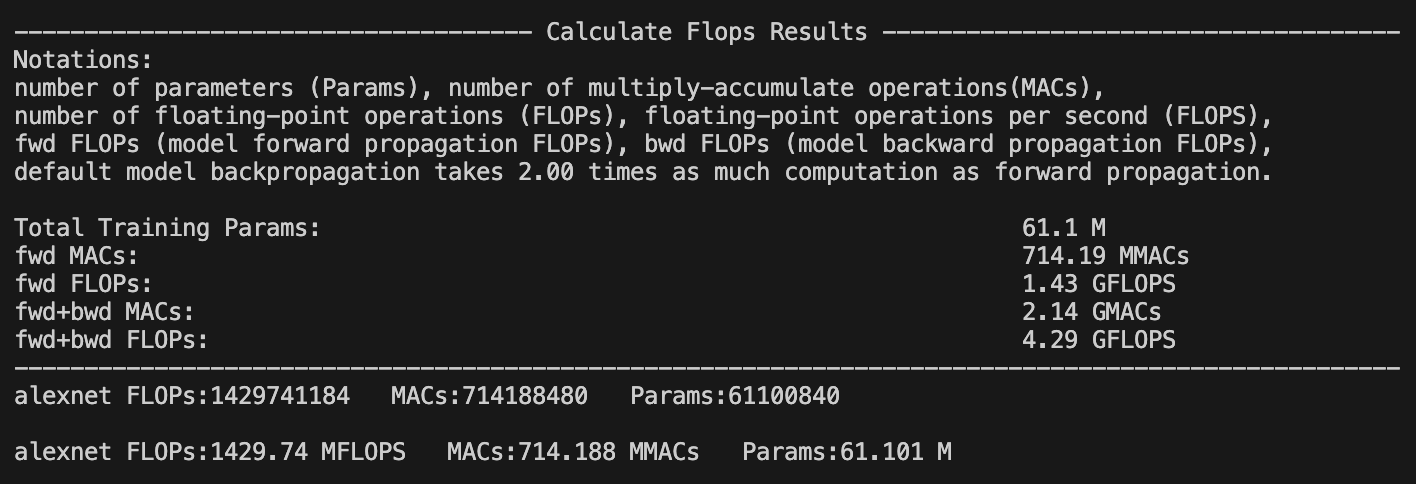
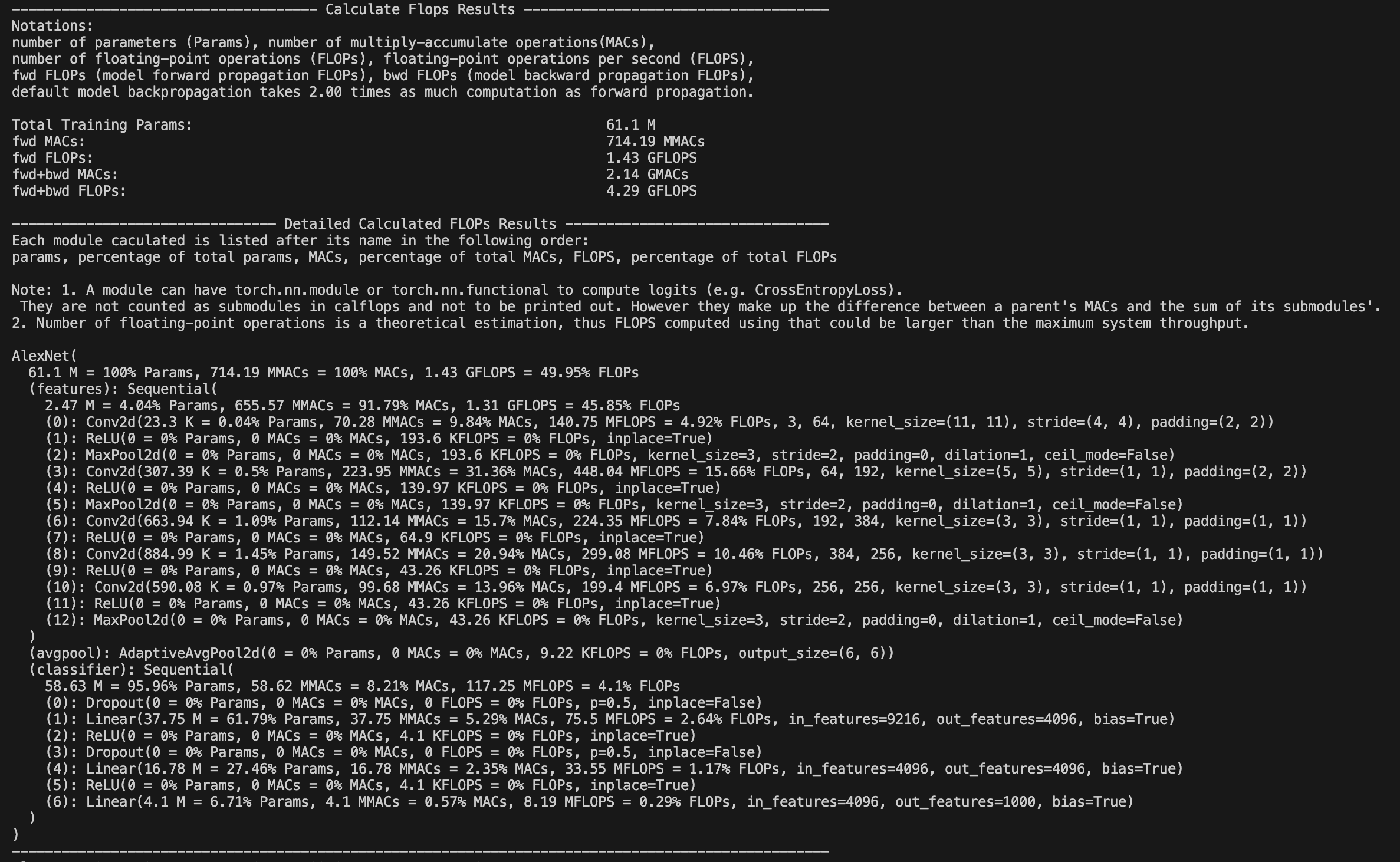
        "description_content_type": "text/markdown",
        "author_email": "MrYXJ <yxj2017@gmail.com>",
        "license": "MIT License\n\nCopyright (c) [2023] [MrYXJ]\n\nPermission is hereby granted, free of charge, to any person obtaining a copy\nof this software and associated documentation files (the \"Software\"), to deal\nin the Software without restriction, including without limitation the rights\nto use, copy, modify, merge, publish, distribute, sublicense, and/or sell\ncopies of the Software, and to permit persons to whom the Software is\nfurnished to do so, subject to the following conditions:\n\nThe above copyright notice and this permission notice shall be included in all\ncopies or substantial portions of the Software.\n\nTHE SOFTWARE IS PROVIDED \"AS IS\", WITHOUT WARRANTY OF ANY KIND, EXPRESS OR\nIMPLIED, INCLUDING BUT NOT LIMITED TO THE WARRANTIES OF MERCHANTABILITY,\nFITNESS FOR A PARTICULAR PURPOSE AND NONINFRINGEMENT. IN NO EVENT SHALL THE\nAUTHORS OR COPYRIGHT HOLDERS BE LIABLE FOR ANY CLAIM, DAMAGES OR OTHER\nLIABILITY, WHETHER IN AN ACTION OF CONTRACT, TORT OR OTHERWISE, ARISING FROM,\nOUT OF OR IN CONNECTION WITH THE SOFTWARE OR THE USE OR OTHER DEALINGS IN THE\nSOFTWARE.",
        "classifier": [
          "License :: OSI Approved :: MIT License",
          "Operating System :: OS Independent",
          "Programming Language :: Python :: 3"
        ],
        "requires_dist": [
          "accelerate>=0.22.0",
          "huggingface-hub>=0.16.4",
          "torch>=1.1.0"
        ],
        "requires_python": ">=3.6",
        "project_url": [
          "Homepage, https://github.com/MrYxJ/calculate-flops.pytorch"
        ]
      }
    },
    {
      "download_info": {
        "url": "https://files.pythonhosted.org/packages/99/55/db07de81b5c630da5cbf5c7df646580ca26dfaefa593667fc6f2fe016d2e/tabulate-0.10.0-py3-none-any.whl",
        "archive_info": {
          "hash": "sha256=f0b0622e567335c8fabaaa659f1b33bcb6ddfe2e496071b743aa113f8774f2d3",
          "hashes": {
            "sha256": "f0b0622e567335c8fabaaa659f1b33bcb6ddfe2e496071b743aa113f8774f2d3"
          }
        }
      },
      "is_direct": false,
      "is_yanked": false,
      "requested": true,
      "metadata": {
        "metadata_version": "2.4",
        "name": "tabulate",
        "version": "0.10.0",
        "dynamic": [
          "license-file"
        ],
        "summary": "Pretty-print tabular data",
        "description": "python-tabulate\r\n===============\r\n\r\nPretty-print tabular data in Python, a library and a command-line\r\nutility.\r\n\r\nThe main use cases of the library are:\r\n\r\n-   printing small tables without hassle: just one function call,\r\n    formatting is guided by the data itself\r\n-   authoring tabular data for lightweight plain-text markup: multiple\r\n    output formats suitable for further editing or transformation\r\n-   readable presentation of mixed textual and numeric data: smart\r\n    column alignment, configurable number formatting, alignment by a\r\n    decimal point\r\n\r\nInstallation\r\n------------\r\n\r\nTo install the Python library and the command line utility, run:\r\n\r\n```shell\r\npip install tabulate\r\n```\r\n\r\nThe command line utility will be installed as `tabulate` to `bin` on\r\nLinux (e.g. `/usr/bin`); or as `tabulate.exe` to `Scripts` in your\r\nPython installation on Windows (e.g. `C:\\Python39\\Scripts\\tabulate.exe`).\r\n\r\nYou may consider installing the library only for the current user:\r\n\r\n```shell\r\npip install tabulate --user\r\n```\r\n\r\nIn this case the command line utility will be installed to\r\n`~/.local/bin/tabulate` on Linux and to\r\n`%APPDATA%\\Python\\Scripts\\tabulate.exe` on Windows.\r\n\r\nTo install just the library on Unix-like operating systems:\r\n\r\n```shell\r\nTABULATE_INSTALL=lib-only pip install tabulate\r\n```\r\n\r\nOn Windows:\r\n\r\n```shell\r\nset TABULATE_INSTALL=lib-only\r\npip install tabulate\r\n```\r\n\r\nBuild status\r\n------------\r\n\r\n[![python-tabulate](https://github.com/astanin/python-tabulate/actions/workflows/tabulate.yml/badge.svg)](https://github.com/astanin/python-tabulate/actions/workflows/tabulate.yml)\r\n\r\nLibrary usage\r\n-------------\r\n\r\nThe module provides just one function, `tabulate`, which takes a list of\r\nlists or another tabular data type as the first argument, and outputs a\r\nnicely formatted plain-text table:\r\n\r\n```pycon\r\n>>> from tabulate import tabulate\r\n\r\n>>> table = [[\"Sun\",696000,1989100000],[\"Earth\",6371,5973.6],\r\n...          [\"Moon\",1737,73.5],[\"Mars\",3390,641.85]]\r\n>>> print(tabulate(table))\r\n-----  ------  -------------\r\nSun    696000     1.9891e+09\r\nEarth    6371  5973.6\r\nMoon     1737    73.5\r\nMars     3390   641.85\r\n-----  ------  -------------\r\n\r\n```\r\n\r\nThe following tabular data types are supported:\r\n\r\n-   list of lists or another iterable of iterables\r\n-   list or another iterable of dicts (keys as columns)\r\n-   dict of iterables (keys as columns)\r\n-   list of dataclasses (field names as columns)\r\n-   two-dimensional NumPy array\r\n-   NumPy record arrays (names as columns)\r\n-   pandas.DataFrame\r\n\r\nTabulate is a Python3 library.\r\n\r\n### Headers\r\n\r\nThe second optional argument named `headers` defines a list of column\r\nheaders to be used:\r\n\r\n```pycon\r\n>>> print(tabulate(table, headers=[\"Planet\",\"R (km)\", \"mass (x 10^29 kg)\"]))\r\nPlanet      R (km)    mass (x 10^29 kg)\r\n--------  --------  -------------------\r\nSun         696000           1.9891e+09\r\nEarth         6371        5973.6\r\nMoon          1737          73.5\r\nMars          3390         641.85\r\n\r\n```\r\n\r\nIf `headers=\"firstrow\"`, then the first row of data is used:\r\n\r\n```pycon\r\n>>> print(tabulate([[\"Name\",\"Age\"],[\"Alice\",24],[\"Bob\",19]],\r\n...                headers=\"firstrow\"))\r\nName      Age\r\n------  -----\r\nAlice      24\r\nBob        19\r\n\r\n```\r\n\r\nIf `headers=\"keys\"`, then the keys of a dictionary/dataframe, or column\r\nindices are used. It also works for NumPy record arrays and lists of\r\ndictionaries or named tuples:\r\n\r\n```pycon\r\n>>> print(tabulate({\"Name\": [\"Alice\", \"Bob\"],\r\n...                 \"Age\": [24, 19]}, headers=\"keys\"))\r\nName      Age\r\n------  -----\r\nAlice      24\r\nBob        19\r\n\r\n```\r\n\r\nWhen data is a list of dictionaries, a dictionary can be passed as `headers`\r\nto replace the keys with other column labels:\r\n\r\n```pycon\r\n>>> print(tabulate([{1: \"Alice\", 2: 24}, {1: \"Bob\", 2: 19}],\r\n...                headers={1: \"Name\", 2: \"Age\"}))\r\nName      Age\r\n------  -----\r\nAlice      24\r\nBob        19\r\n\r\n```\r\n\r\n### Row Indices\r\n\r\nBy default, only pandas.DataFrame tables have an additional column\r\ncalled row index. To add a similar column to any other type of table,\r\npass `showindex=\"always\"` or `showindex=True` argument to `tabulate()`.\r\nTo suppress row indices for all types of data, pass `showindex=\"never\"`\r\nor `showindex=False`. To add a custom row index column, pass\r\n`showindex=rowIDs`, where `rowIDs` is some iterable:\r\n\r\n```pycon\r\n>>> print(tabulate([[\"F\",24],[\"M\",19]], showindex=\"always\"))\r\n-  -  --\r\n0  F  24\r\n1  M  19\r\n-  -  --\r\n\r\n```\r\n\r\n### Table format\r\n\r\nThere is more than one way to format a table in plain text. The third\r\noptional argument named `tablefmt` defines how the table is formatted.\r\n\r\nSupported table formats are:\r\n\r\n-   \"plain\"\r\n-   \"simple\"\r\n-   \"github\"\r\n-   \"grid\"\r\n-   \"simple\\_grid\"\r\n-   \"rounded\\_grid\"\r\n-   \"heavy\\_grid\"\r\n-   \"mixed\\_grid\"\r\n-   \"double\\_grid\"\r\n-   \"fancy\\_grid\"\r\n-   \"outline\"\r\n-   \"simple\\_outline\"\r\n-   \"rounded\\_outline\"\r\n-   \"heavy\\_outline\"\r\n-   \"mixed\\_outline\"\r\n-   \"double\\_outline\"\r\n-   \"fancy\\_outline\"\r\n-   \"pipe\"\r\n-   \"orgtbl\"\r\n-   \"asciidoc\"\r\n-   \"jira\"\r\n-   \"presto\"\r\n-   \"pretty\"\r\n-   \"psql\"\r\n-   \"rst\"\r\n-   \"mediawiki\"\r\n-   \"moinmoin\"\r\n-   \"youtrack\"\r\n-   \"html\"\r\n-   \"unsafehtml\"\r\n-   \"latex\"\r\n-   \"latex\\_raw\"\r\n-   \"latex\\_booktabs\"\r\n-   \"latex\\_longtable\"\r\n-   \"textile\"\r\n-   \"tsv\"\r\n\r\n`plain` tables do not use any pseudo-graphics to draw lines:\r\n\r\n```pycon\r\n>>> table = [[\"spam\",42],[\"eggs\",451],[\"bacon\",0]]\r\n>>> headers = [\"item\", \"qty\"]\r\n>>> print(tabulate(table, headers, tablefmt=\"plain\"))\r\nitem      qty\r\nspam       42\r\neggs      451\r\nbacon       0\r\n\r\n```\r\n\r\n`simple` is the default format (the default may change in future\r\nversions). It corresponds to `simple_tables` in [Pandoc Markdown\r\nextensions](http://johnmacfarlane.net/pandoc/README.html#tables):\r\n\r\n```pycon\r\n>>> print(tabulate(table, headers, tablefmt=\"simple\"))\r\nitem      qty\r\n------  -----\r\nspam       42\r\neggs      451\r\nbacon       0\r\n\r\n```\r\n\r\n`github` follows the conventions of GitHub flavored Markdown. It\r\ncorresponds to the `pipe` format without alignment colons:\r\n\r\n```pycon\r\n>>> print(tabulate(table, headers, tablefmt=\"github\"))\r\n| item   |   qty |\r\n|--------|-------|\r\n| spam   |    42 |\r\n| eggs   |   451 |\r\n| bacon  |     0 |\r\n\r\n```\r\n\r\n`grid` is like tables formatted by Emacs'\r\n[table.el](http://table.sourceforge.net/) package. It corresponds to\r\n`grid_tables` in Pandoc Markdown extensions:\r\n\r\n```pycon\r\n>>> print(tabulate(table, headers, tablefmt=\"grid\"))\r\n+--------+-------+\r\n| item   |   qty |\r\n+========+=======+\r\n| spam   |    42 |\r\n+--------+-------+\r\n| eggs   |   451 |\r\n+--------+-------+\r\n| bacon  |     0 |\r\n+--------+-------+\r\n\r\n```\r\n\r\n`simple_grid` draws a grid using single-line box-drawing characters:\r\n\r\n    >>> print(tabulate(table, headers, tablefmt=\"simple_grid\"))\r\n    ┌────────┬───────┐\r\n    │ item   │   qty │\r\n    ├────────┼───────┤\r\n    │ spam   │    42 │\r\n    ├────────┼───────┤\r\n    │ eggs   │   451 │\r\n    ├────────┼───────┤\r\n    │ bacon  │     0 │\r\n    └────────┴───────┘\r\n\r\n`rounded_grid` draws a grid using single-line box-drawing characters with rounded corners:\r\n\r\n    >>> print(tabulate(table, headers, tablefmt=\"rounded_grid\"))\r\n    ╭────────┬───────╮\r\n    │ item   │   qty │\r\n    ├────────┼───────┤\r\n    │ spam   │    42 │\r\n    ├────────┼───────┤\r\n    │ eggs   │   451 │\r\n    ├────────┼───────┤\r\n    │ bacon  │     0 │\r\n    ╰────────┴───────╯\r\n\r\n`heavy_grid` draws a grid using bold (thick) single-line box-drawing characters:\r\n\r\n    >>> print(tabulate(table, headers, tablefmt=\"heavy_grid\"))\r\n    ┏━━━━━━━━┳━━━━━━━┓\r\n    ┃ item   ┃   qty ┃\r\n    ┣━━━━━━━━╋━━━━━━━┫\r\n    ┃ spam   ┃    42 ┃\r\n    ┣━━━━━━━━╋━━━━━━━┫\r\n    ┃ eggs   ┃   451 ┃\r\n    ┣━━━━━━━━╋━━━━━━━┫\r\n    ┃ bacon  ┃     0 ┃\r\n    ┗━━━━━━━━┻━━━━━━━┛\r\n\r\n`mixed_grid` draws a grid using a mix of light (thin) and heavy (thick) lines box-drawing characters:\r\n\r\n    >>> print(tabulate(table, headers, tablefmt=\"mixed_grid\"))\r\n    ┍━━━━━━━━┯━━━━━━━┑\r\n    │ item   │   qty │\r\n    ┝━━━━━━━━┿━━━━━━━┥\r\n    │ spam   │    42 │\r\n    ├────────┼───────┤\r\n    │ eggs   │   451 │\r\n    ├────────┼───────┤\r\n    │ bacon  │     0 │\r\n    ┕━━━━━━━━┷━━━━━━━┙\r\n\r\n`double_grid` draws a grid using double-line box-drawing characters:\r\n\r\n    >>> print(tabulate(table, headers, tablefmt=\"double_grid\"))\r\n    ╔════════╦═══════╗\r\n    ║ item   ║   qty ║\r\n    ╠════════╬═══════╣\r\n    ║ spam   ║    42 ║\r\n    ╠════════╬═══════╣\r\n    ║ eggs   ║   451 ║\r\n    ╠════════╬═══════╣\r\n    ║ bacon  ║     0 ║\r\n    ╚════════╩═══════╝\r\n\r\n`fancy_grid` draws a grid using a mix of single and\r\n    double-line box-drawing characters:\r\n\r\n```pycon\r\n>>> print(tabulate(table, headers, tablefmt=\"fancy_grid\"))\r\n╒════════╤═══════╕\r\n│ item   │   qty │\r\n╞════════╪═══════╡\r\n│ spam   │    42 │\r\n├────────┼───────┤\r\n│ eggs   │   451 │\r\n├────────┼───────┤\r\n│ bacon  │     0 │\r\n╘════════╧═══════╛\r\n\r\n```\r\n\r\n`colon_grid` is similar to `grid` but uses colons only to define\r\ncolumnwise content alignment , without whitespace padding,\r\nsimilar the alignment specification of Pandoc `grid_tables`:\r\n\r\n    >>> print(tabulate([[\"spam\", 41.9999], [\"eggs\", \"451.0\"]],\r\n    ...                [\"strings\", \"numbers\"], \"colon_grid\",\r\n    ...                colalign=[\"right\", \"left\"]))\r\n    +-----------+-----------+\r\n    | strings   | numbers   |\r\n    +==========:+:==========+\r\n    | spam      | 41.9999   |\r\n    +-----------+-----------+\r\n    | eggs      | 451       |\r\n    +-----------+-----------+\r\n\r\n\r\n`outline` is the same as the `grid` format but doesn't draw lines between rows:\r\n\r\n    >>> print(tabulate(table, headers, tablefmt=\"outline\"))\r\n    +--------+-------+\r\n    | item   |   qty |\r\n    +========+=======+\r\n    | spam   |    42 |\r\n    | eggs   |   451 |\r\n    | bacon  |     0 |\r\n    +--------+-------+\r\n\r\n`simple_outline` is the same as the `simple_grid` format but doesn't draw lines between rows:\r\n\r\n    >>> print(tabulate(table, headers, tablefmt=\"simple_outline\"))\r\n    ┌────────┬───────┐\r\n    │ item   │   qty │\r\n    ├────────┼───────┤\r\n    │ spam   │    42 │\r\n    │ eggs   │   451 │\r\n    │ bacon  │     0 │\r\n    └────────┴───────┘\r\n\r\n`rounded_outline` is the same as the `rounded_grid` format but doesn't draw lines between rows:\r\n\r\n    >>> print(tabulate(table, headers, tablefmt=\"rounded_outline\"))\r\n    ╭────────┬───────╮\r\n    │ item   │   qty │\r\n    ├────────┼───────┤\r\n    │ spam   │    42 │\r\n    │ eggs   │   451 │\r\n    │ bacon  │     0 │\r\n    ╰────────┴───────╯\r\n\r\n`heavy_outline` is the same as the `heavy_grid` format but doesn't draw lines between rows:\r\n\r\n    >>> print(tabulate(table, headers, tablefmt=\"heavy_outline\"))\r\n    ┏━━━━━━━━┳━━━━━━━┓\r\n    ┃ item   ┃   qty ┃\r\n    ┣━━━━━━━━╋━━━━━━━┫\r\n    ┃ spam   ┃    42 ┃\r\n    ┃ eggs   ┃   451 ┃\r\n    ┃ bacon  ┃     0 ┃\r\n    ┗━━━━━━━━┻━━━━━━━┛\r\n\r\n`mixed_outline` is the same as the `mixed_grid` format but doesn't draw lines between rows:\r\n\r\n    >>> print(tabulate(table, headers, tablefmt=\"mixed_outline\"))\r\n    ┍━━━━━━━━┯━━━━━━━┑\r\n    │ item   │   qty │\r\n    ┝━━━━━━━━┿━━━━━━━┥\r\n    │ spam   │    42 │\r\n    │ eggs   │   451 │\r\n    │ bacon  │     0 │\r\n    ┕━━━━━━━━┷━━━━━━━┙\r\n\r\n`double_outline` is the same as the `double_grid` format but doesn't draw lines between rows:\r\n\r\n    >>> print(tabulate(table, headers, tablefmt=\"double_outline\"))\r\n    ╔════════╦═══════╗\r\n    ║ item   ║   qty ║\r\n    ╠════════╬═══════╣\r\n    ║ spam   ║    42 ║\r\n    ║ eggs   ║   451 ║\r\n    ║ bacon  ║     0 ║\r\n    ╚════════╩═══════╝\r\n\r\n`fancy_outline` is the same as the `fancy_grid` format but doesn't draw lines between rows:\r\n\r\n    >>> print(tabulate(table, headers, tablefmt=\"fancy_outline\"))\r\n    ╒════════╤═══════╕\r\n    │ item   │   qty │\r\n    ╞════════╪═══════╡\r\n    │ spam   │    42 │\r\n    │ eggs   │   451 │\r\n    │ bacon  │     0 │\r\n    ╘════════╧═══════╛\r\n\r\n`presto` is like tables formatted by Presto cli:\r\n\r\n```pycon\r\n>>> print(tabulate(table, headers, tablefmt=\"presto\"))\r\n item   |   qty\r\n--------+-------\r\n spam   |    42\r\n eggs   |   451\r\n bacon  |     0\r\n\r\n```\r\n\r\n`pretty` attempts to be close to the format emitted by the PrettyTables\r\nlibrary:\r\n\r\n```pycon\r\n>>> print(tabulate(table, headers, tablefmt=\"pretty\"))\r\n+-------+-----+\r\n| item  | qty |\r\n+-------+-----+\r\n| spam  | 42  |\r\n| eggs  | 451 |\r\n| bacon |  0  |\r\n+-------+-----+\r\n\r\n```\r\n\r\n`psql` is like tables formatted by Postgres' psql cli:\r\n\r\n```pycon\r\n>>> print(tabulate(table, headers, tablefmt=\"psql\"))\r\n+--------+-------+\r\n| item   |   qty |\r\n|--------+-------|\r\n| spam   |    42 |\r\n| eggs   |   451 |\r\n| bacon  |     0 |\r\n+--------+-------+\r\n\r\n```\r\n\r\n`pipe` follows the conventions of [PHP Markdown\r\nExtra](http://michelf.ca/projects/php-markdown/extra/#table) extension.\r\nIt corresponds to `pipe_tables` in Pandoc. This format uses colons to\r\nindicate column alignment:\r\n\r\n```pycon\r\n>>> print(tabulate(table, headers, tablefmt=\"pipe\"))\r\n| item   |   qty |\r\n|:-------|------:|\r\n| spam   |    42 |\r\n| eggs   |   451 |\r\n| bacon  |     0 |\r\n\r\n```\r\n\r\n`asciidoc` formats data like a simple table of the\r\n[AsciiDoctor](https://docs.asciidoctor.org/asciidoc/latest/syntax-quick-reference/#tables)\r\nformat:\r\n\r\n```pycon\r\n>>> print(tabulate(table, headers, tablefmt=\"asciidoc\"))\r\n[cols=\"<8,>7\",options=\"header\"]\r\n|====\r\n| item   |   qty\r\n| spam   |    42\r\n| eggs   |   451\r\n| bacon  |     0\r\n|====\r\n\r\n```\r\n\r\n`orgtbl` follows the conventions of Emacs\r\n[org-mode](http://orgmode.org/manual/Tables.html), and is editable also\r\nin the minor orgtbl-mode. Hence its name:\r\n\r\n```pycon\r\n>>> print(tabulate(table, headers, tablefmt=\"orgtbl\"))\r\n| item   |   qty |\r\n|--------+-------|\r\n| spam   |    42 |\r\n| eggs   |   451 |\r\n| bacon  |     0 |\r\n\r\n```\r\n\r\n`jira` follows the conventions of Atlassian Jira markup language:\r\n\r\n```pycon\r\n>>> print(tabulate(table, headers, tablefmt=\"jira\"))\r\n|| item   ||   qty ||\r\n| spam   |    42 |\r\n| eggs   |   451 |\r\n| bacon  |     0 |\r\n\r\n```\r\n\r\n`rst` formats data like a simple table of the\r\n[reStructuredText](http://docutils.sourceforge.net/docs/user/rst/quickref.html#tables)\r\nformat:\r\n\r\n```pycon\r\n>>> print(tabulate(table, headers, tablefmt=\"rst\"))\r\n======  =====\r\nitem      qty\r\n======  =====\r\nspam       42\r\neggs      451\r\nbacon       0\r\n======  =====\r\n\r\n```\r\n\r\n`mediawiki` format produces a table markup used in\r\n[Wikipedia](http://www.mediawiki.org/wiki/Help:Tables) and on other\r\nMediaWiki-based sites:\r\n\r\n ```pycon\r\n>>> print(tabulate(table, headers, tablefmt=\"mediawiki\"))\r\n{| class=\"wikitable\" style=\"text-align: left;\"\r\n|+ <!-- caption -->\r\n|-\r\n! item   !! style=\"text-align: right;\"|   qty\r\n|-\r\n| spam   || style=\"text-align: right;\"|    42\r\n|-\r\n| eggs   || style=\"text-align: right;\"|   451\r\n|-\r\n| bacon  || style=\"text-align: right;\"|     0\r\n|}\r\n\r\n```\r\n\r\n`moinmoin` format produces a table markup used in\r\n[MoinMoin](https://moinmo.in/) wikis:\r\n\r\n```pycon\r\n>>> print(tabulate(table, headers, tablefmt=\"moinmoin\"))\r\n|| ''' item   ''' ||<style=\"text-align: right;\"> '''   qty ''' ||\r\n||  spam    ||<style=\"text-align: right;\">     42  ||\r\n||  eggs    ||<style=\"text-align: right;\">    451  ||\r\n||  bacon   ||<style=\"text-align: right;\">      0  ||\r\n\r\n```\r\n\r\n`youtrack` format produces a table markup used in Youtrack tickets:\r\n\r\n```pycon\r\n>>> print(tabulate(table, headers, tablefmt=\"youtrack\"))\r\n||  item    ||    qty  ||\r\n|  spam    |     42  |\r\n|  eggs    |    451  |\r\n|  bacon   |      0  |\r\n\r\n```\r\n\r\n`textile` format produces a table markup used in\r\n[Textile](http://redcloth.org/hobix.com/textile/) format:\r\n\r\n```pycon\r\n>>> print(tabulate(table, headers, tablefmt=\"textile\"))\r\n|_.  item   |_.   qty |\r\n|<. spam    |>.    42 |\r\n|<. eggs    |>.   451 |\r\n|<. bacon   |>.     0 |\r\n\r\n```\r\n\r\n`html` produces standard HTML markup as an html.escape'd str\r\nwith a ._repr_html_ method so that Jupyter Lab and Notebook display the HTML\r\nand a .str property so that the raw HTML remains accessible.\r\n`unsafehtml` table format can be used if an unescaped HTML is required:\r\n\r\n```pycon\r\n>>> print(tabulate(table, headers, tablefmt=\"html\"))\r\n<table>\r\n<thead>\r\n<tr><th>item  </th><th style=\"text-align: right;\">  qty</th></tr>\r\n</thead>\r\n<tbody>\r\n<tr><td>spam  </td><td style=\"text-align: right;\">   42</td></tr>\r\n<tr><td>eggs  </td><td style=\"text-align: right;\">  451</td></tr>\r\n<tr><td>bacon </td><td style=\"text-align: right;\">    0</td></tr>\r\n</tbody>\r\n</table>\r\n\r\n```\r\n\r\n`latex` format creates a `tabular` environment for LaTeX markup,\r\nreplacing special characters like `_` or `\\` to their LaTeX\r\ncorrespondents:\r\n\r\n```pycon\r\n>>> print(tabulate(table, headers, tablefmt=\"latex\"))\r\n\\begin{tabular}{lr}\r\n\\hline\r\n item   &   qty \\\\\r\n\\hline\r\n spam   &    42 \\\\\r\n eggs   &   451 \\\\\r\n bacon  &     0 \\\\\r\n\\hline\r\n\\end{tabular}\r\n\r\n```\r\n\r\n`latex_raw` behaves like `latex` but does not escape LaTeX commands and\r\nspecial characters.\r\n\r\n`latex_booktabs` creates a `tabular` environment for LaTeX markup using\r\nspacing and style from the `booktabs` package.\r\n\r\n`latex_longtable` creates a table that can stretch along multiple pages,\r\nusing the `longtable` package.\r\n\r\n### Column alignment\r\n\r\n`tabulate` is smart about column alignment. It detects columns which\r\ncontain only numbers, and aligns them by a decimal point (or flushes\r\nthem to the right if they appear to be integers). Text columns are\r\nflushed to the left.\r\n\r\nYou can override the default alignment with `numalign` and `stralign`\r\nnamed arguments. Possible column alignments are: `right`, `center`,\r\n`left`, `decimal` (only for numbers), and `None` (to disable alignment).\r\n\r\nAligning by a decimal point works best when you need to compare numbers\r\nat a glance:\r\n\r\n```pycon\r\n>>> print(tabulate([[1.2345],[123.45],[12.345],[12345],[1234.5]]))\r\n----------\r\n    1.2345\r\n  123.45\r\n   12.345\r\n12345\r\n 1234.5\r\n----------\r\n\r\n```\r\n\r\nCompare this with a more common right alignment:\r\n\r\n```pycon\r\n>>> print(tabulate([[1.2345],[123.45],[12.345],[12345],[1234.5]], numalign=\"right\"))\r\n------\r\n1.2345\r\n123.45\r\n12.345\r\n 12345\r\n1234.5\r\n------\r\n\r\n```\r\n\r\nFor `tabulate`, anything which can be parsed as a number is a number.\r\nEven numbers represented as strings are aligned properly. This feature\r\ncomes in handy when reading a mixed table of text and numbers from a\r\nfile:\r\n\r\n```pycon\r\n>>> import csv; from io import StringIO\r\n>>> table = list(csv.reader(StringIO(\"spam, 42\\neggs, 451\\n\")))\r\n>>> table\r\n[['spam', ' 42'], ['eggs', ' 451']]\r\n>>> print(tabulate(table))\r\n----  ----\r\nspam    42\r\neggs   451\r\n----  ----\r\n\r\n```\r\n\r\nTo disable this feature use `disable_numparse=True`.\r\n\r\n```pycon\r\n>>> print(tabulate([[\"Ver1\", \"18.0\"], [\"Ver2\",\"19.2\"]], tablefmt=\"simple\", disable_numparse=True))\r\n----  ----\r\nVer1  18.0\r\nVer2  19.2\r\n----  ----\r\n\r\n```\r\n\r\n### Custom column alignment\r\n\r\n`tabulate` allows a custom column alignment to override the smart alignment described above.\r\nUse `colglobalalign` to define a global setting. Possible alignments are: `right`, `center`, `left`, `decimal` (only for numbers).\r\nFurthermore, you can define `colalign` for column-specific alignment as a list or a tuple. Possible values are `global` (keeps global setting), `right`, `center`, `left`, `decimal` (only for numbers), `None` (to disable alignment). Missing alignments are treated as `global`.\r\n\r\n```pycon\r\n>>> print(tabulate([[1,2,3,4],[111,222,333,444]], colglobalalign='center', colalign = ('global','left','right')))\r\n---  ---  ---  ---\r\n 1   2      3   4\r\n111  222  333  444\r\n---  ---  ---  ---\r\n\r\n```\r\n\r\n### Custom header alignment\r\n\r\nHeaders' alignment can be defined separately from columns'. Like for columns, you can use:\r\n- `headersglobalalign` to define a header-specific global alignment setting. Possible values are `right`, `center`, `left`, `None` (to follow column alignment),\r\n- `headersalign` list or tuple to further specify header-wise alignment. Possible values are `global` (keeps global setting), `same` (follow column alignment), `right`, `center`, `left`, `None` (to disable alignment). Missing alignments are treated as `global`.\r\n\r\n```pycon\r\n>>> print(tabulate([[1,2,3,4,5,6],[111,222,333,444,555,666]], colglobalalign = 'center', colalign = ('left',), headers = ['h','e','a','d','e','r'], headersglobalalign = 'right', headersalign = ('same','same','left','global','center')))\r\nh     e   a      d   e     r\r\n---  ---  ---  ---  ---  ---\r\n1     2    3    4    5    6\r\n111  222  333  444  555  666\r\n\r\n```\r\n\r\n### Number formatting\r\n\r\n`tabulate` allows to define custom number formatting applied to all\r\ncolumns of decimal numbers. Use `floatfmt` named argument:\r\n\r\n```pycon\r\n>>> print(tabulate([[\"pi\",3.141593],[\"e\",2.718282]], floatfmt=\".4f\"))\r\n--  ------\r\npi  3.1416\r\ne   2.7183\r\n--  ------\r\n\r\n```\r\n\r\n`floatfmt` argument can be a list or a tuple of format strings, one per\r\ncolumn, in which case every column may have different number formatting:\r\n\r\n```pycon\r\n>>> print(tabulate([[0.12345, 0.12345, 0.12345]], floatfmt=(\".1f\", \".3f\")))\r\n---  -----  -------\r\n0.1  0.123  0.12345\r\n---  -----  -------\r\n\r\n```\r\n\r\n`intfmt` works similarly for integers\r\n\r\n    >>> print(tabulate([[\"a\",1000],[\"b\",90000]], intfmt=\",\"))\r\n    -  ------\r\n    a   1,000\r\n    b  90,000\r\n    -  ------\r\n\r\n\r\n### Type Deduction and Missing Values\r\n\r\nWhen `tabulate` sees numerical data (with our without comma separators), it\r\nattempts to align the column on the decimal point.  However, if it observes\r\nnon-numerical data in the column, it aligns it to the left by default.  If\r\ndata is missing in a column (either None or empty values), the remaining\r\ndata in the column is used to infer the type:\r\n\r\n```pycon\r\n>>> from fractions import Fraction\r\n>>> test_table = [\r\n...    [None, \"1.23423515351\", Fraction(1, 3)],\r\n...    [Fraction(56789, 1000000), 12345.1, b\"abc\"],\r\n...    [\"\", b\"\", None],\r\n...    [Fraction(10000, 3), None, \"\"],\r\n... ]\r\n>>> print(tabulate(test_table, floatfmt=\",.5g\", missingval=\"?\"))\r\n------------  -----------  ---\r\n    ?              1.2342  1/3\r\n    0.056789  12,345       abc\r\n                           ?\r\n3,333.3            ?\r\n------------  -----------  ---\r\n\r\n```\r\n\r\nThe deduced type (eg. str, float) influences the rendering of any types\r\nthat have alternative representations.  For example, since `Fraction` has\r\nmethods `__str__` and `__float__` defined (and hence is convertible to a\r\n`float` and also has a `str` representation), the appropriate\r\nrepresentation is selected for the column's deduced type.  In order to not\r\nlose precision accidentally, types having both an `__int__` and\r\n`__float__` representation will be considered a `float`.\r\n\r\nTherefore, if your table contains types convertible to int/float but you'd\r\n*prefer* they be represented as strings, or your strings *might* all look\r\nlike numbers such as \"1e23\": either convert them to the desired\r\nrepresentation before you `tabulate`, or ensure that the column always\r\ncontains at least one other `str`.\r\n\r\n### Text formatting\r\n\r\nBy default, `tabulate` removes leading and trailing whitespace from text\r\ncolumns. To disable whitespace removal, pass `preserve_whitespace=True`.\r\nOlder versions of the library used a global module-level flag PRESERVE_WHITESPACE.\r\n\r\n### Wide (fullwidth CJK) symbols\r\n\r\nTo properly align tables which contain wide characters (typically\r\nfullwidth glyphs from Chinese, Japanese or Korean languages), the user\r\nshould install `wcwidth` library. To install it together with\r\n`tabulate`:\r\n\r\n```shell\r\npip install tabulate[widechars]\r\n```\r\n\r\nWide character support is enabled automatically if `wcwidth` library is\r\nalready installed. To disable wide characters support without\r\nuninstalling `wcwidth`, set the global module-level flag\r\n`WIDE_CHARS_MODE`:\r\n\r\n```python\r\nimport tabulate\r\ntabulate.WIDE_CHARS_MODE = False\r\n```\r\n\r\n### Multiline cells\r\n\r\nMost table formats support multiline cell text (text containing newline\r\ncharacters). The newline characters are honored as line break\r\ncharacters.\r\n\r\nMultiline cells are supported for data rows and for header rows.\r\n\r\nFurther automatic line breaks are not inserted. Of course, some output\r\nformats such as latex or html handle automatic formatting of the cell\r\ncontent on their own, but for those that don't, the newline characters\r\nin the input cell text are the only means to break a line in cell text.\r\n\r\nNote that some output formats (e.g. simple, or plain) do not represent\r\nrow delimiters, so that the representation of multiline cells in such\r\nformats may be ambiguous to the reader.\r\n\r\nThe following examples of formatted output use the following table with\r\na multiline cell, and headers with a multiline cell:\r\n\r\n```pycon\r\n>>> table = [[\"eggs\",451],[\"more\\nspam\",42]]\r\n>>> headers = [\"item\\nname\", \"qty\"]\r\n\r\n```\r\n\r\n`plain` tables:\r\n\r\n```pycon\r\n>>> print(tabulate(table, headers, tablefmt=\"plain\"))\r\nitem      qty\r\nname\r\neggs      451\r\nmore       42\r\nspam\r\n\r\n```\r\n\r\n`simple` tables:\r\n\r\n```pycon\r\n>>> print(tabulate(table, headers, tablefmt=\"simple\"))\r\nitem      qty\r\nname\r\n------  -----\r\neggs      451\r\nmore       42\r\nspam\r\n\r\n```\r\n\r\n`grid` tables:\r\n\r\n```pycon\r\n>>> print(tabulate(table, headers, tablefmt=\"grid\"))\r\n+--------+-------+\r\n| item   |   qty |\r\n| name   |       |\r\n+========+=======+\r\n| eggs   |   451 |\r\n+--------+-------+\r\n| more   |    42 |\r\n| spam   |       |\r\n+--------+-------+\r\n\r\n```\r\n\r\n`fancy_grid` tables:\r\n\r\n```pycon\r\n>>> print(tabulate(table, headers, tablefmt=\"fancy_grid\"))\r\n╒════════╤═══════╕\r\n│ item   │   qty │\r\n│ name   │       │\r\n╞════════╪═══════╡\r\n│ eggs   │   451 │\r\n├────────┼───────┤\r\n│ more   │    42 │\r\n│ spam   │       │\r\n╘════════╧═══════╛\r\n\r\n```\r\n\r\n`pipe` tables:\r\n\r\n```pycon\r\n>>> print(tabulate(table, headers, tablefmt=\"pipe\"))\r\n| item   |   qty |\r\n| name   |       |\r\n|:-------|------:|\r\n| eggs   |   451 |\r\n| more   |    42 |\r\n| spam   |       |\r\n\r\n```\r\n\r\n`orgtbl` tables:\r\n\r\n```pycon\r\n>>> print(tabulate(table, headers, tablefmt=\"orgtbl\"))\r\n| item   |   qty |\r\n| name   |       |\r\n|--------+-------|\r\n| eggs   |   451 |\r\n| more   |    42 |\r\n| spam   |       |\r\n\r\n```\r\n\r\n`jira` tables:\r\n\r\n```pycon\r\n>>> print(tabulate(table, headers, tablefmt=\"jira\"))\r\n|| item   ||   qty ||\r\n|| name   ||       ||\r\n| eggs   |   451 |\r\n| more   |    42 |\r\n| spam   |       |\r\n\r\n```\r\n\r\n`presto` tables:\r\n\r\n```pycon\r\n>>> print(tabulate(table, headers, tablefmt=\"presto\"))\r\n item   |   qty\r\n name   |\r\n--------+-------\r\n eggs   |   451\r\n more   |    42\r\n spam   |\r\n\r\n```\r\n\r\n`pretty` tables:\r\n\r\n```pycon\r\n>>> print(tabulate(table, headers, tablefmt=\"pretty\"))\r\n+------+-----+\r\n| item | qty |\r\n| name |     |\r\n+------+-----+\r\n| eggs | 451 |\r\n| more | 42  |\r\n| spam |     |\r\n+------+-----+\r\n\r\n```\r\n\r\n`psql` tables:\r\n\r\n```pycon\r\n>>> print(tabulate(table, headers, tablefmt=\"psql\"))\r\n+--------+-------+\r\n| item   |   qty |\r\n| name   |       |\r\n|--------+-------|\r\n| eggs   |   451 |\r\n| more   |    42 |\r\n| spam   |       |\r\n+--------+-------+\r\n\r\n```\r\n\r\n`rst` tables:\r\n\r\n```pycon\r\n>>> print(tabulate(table, headers, tablefmt=\"rst\"))\r\n======  =====\r\nitem      qty\r\nname\r\n======  =====\r\neggs      451\r\nmore       42\r\nspam\r\n======  =====\r\n\r\n```\r\n\r\nMultiline cells are not well-supported for the other table formats.\r\n\r\n### Automating Multilines\r\nWhile tabulate supports data passed in with multilines entries explicitly provided,\r\nit also provides some support to help manage this work internally.\r\n\r\nThe `maxcolwidths` argument is a list where each entry specifies the max width for\r\nit's respective column. Any cell that will exceed this will automatically wrap the content.\r\nTo assign the same max width for all columns, a singular int scaler can be used.\r\n\r\nUse `None` for any columns where an explicit maximum does not need to be provided,\r\nand thus no automate multiline wrapping will take place.\r\n\r\nThe wrapping uses the python standard [textwrap.wrap](https://docs.python.org/3/library/textwrap.html#textwrap.wrap)\r\nfunction with default parameters - aside from width.\r\n\r\nThis example demonstrates usage of automatic multiline wrapping, though typically\r\nthe lines being wrapped would probably be significantly longer than this.\r\n\r\n```pycon\r\n>>> print(tabulate([[\"John Smith\", \"Middle Manager\"]], headers=[\"Name\", \"Title\"], tablefmt=\"grid\", maxcolwidths=[None, 8]))\r\n+------------+---------+\r\n| Name       | Title   |\r\n+============+=========+\r\n| John Smith | Middle  |\r\n|            | Manager |\r\n+------------+---------+\r\n\r\n```\r\n\r\nText is preferably wrapped on whitespaces and right after the hyphens in hyphenated words.\r\n\r\nbreak_long_words (default: True)  If true, then words longer than width will be broken in order to ensure that no lines are longer than width.\r\nIf it is false, long words will not be broken, and some lines may be longer than width.\r\n(Long words will be put on a line by themselves, in order to minimize the amount by which width is exceeded.)\r\n\r\nbreak_on_hyphens (default: True) If true, wrapping will occur preferably on whitespaces and right after hyphens in compound words, as it is customary in English.\r\nIf false, only whitespaces will be considered as potentially good places for line breaks.\r\n\r\n```pycon\r\n>>> print(tabulate([[\"John Smith\", \"Middle-Manager\"]], headers=[\"Name\", \"Title\"], tablefmt=\"grid\", maxcolwidths=[None, 5], break_long_words=False))\r\n+------------+---------+\r\n| Name       | Title   |\r\n+============+=========+\r\n| John Smith | Middle- |\r\n|            | Manager |\r\n+------------+---------+\r\n>>> print(tabulate([[\"John Smith\", \"Middle-Manager\"]], headers=[\"Name\", \"Title\"], tablefmt=\"grid\", maxcolwidths=[None, 5], break_long_words=False, break_on_hyphens=False))\r\n+------------+----------------+\r\n| Name       | Title          |\r\n+============+================+\r\n| John Smith | Middle-Manager |\r\n+------------+----------------+\r\n```\r\n\r\n### Adding Separating lines\r\nOne might want to add one or more separating lines to highlight different sections in a table.\r\n\r\nThe separating lines will be of the same type as the one defined by the specified formatter as either the\r\nlinebetweenrows, linebelowheader, linebelow, lineabove or just a simple empty line when none is defined for the formatter\r\n\r\n\r\n    >>> from tabulate import tabulate, SEPARATING_LINE\r\n\r\n    table = [[\"Earth\",6371],\r\n             [\"Mars\",3390],\r\n             SEPARATING_LINE,\r\n             [\"Moon\",1737]]\r\n    print(tabulate(table, tablefmt=\"simple\"))\r\n    -----  ----\r\n    Earth  6371\r\n    Mars   3390\r\n    -----  ----\r\n    Moon   1737\r\n    -----  ----\r\n\r\n### ANSI support\r\nANSI escape codes are non-printable byte sequences usually used for terminal operations like setting\r\ncolor output or modifying cursor positions. Because multi-byte ANSI sequences are inherently non-printable,\r\nthey can still introduce unwanted extra length to strings. For example:\r\n\r\n    >>> len('\\033[31mthis text is red\\033[0m')  # printable length is 16\r\n    25\r\n\r\nTo deal with this, string lengths are calculated after first removing all ANSI escape sequences. This ensures\r\nthat the actual printable length is used for column widths, rather than the byte length. In the final, printable\r\ntable, however, ANSI escape sequences are not removed so the original styling is preserved.\r\n\r\nSome terminals support a special grouping of ANSI escape sequences that are intended to display hyperlinks\r\nmuch in the same way they are shown in browsers. These are handled just as mentioned before: non-printable\r\nANSI escape sequences are removed prior to string length calculation. The only difference with escaped\r\nhyperlinks is that column width will be based on the length of the URL _text_ rather than the URL\r\nitself (terminals would show this text). For example:\r\n\r\n    >>> len('\\x1b]8;;https://example.com\\x1b\\\\example\\x1b]8;;\\x1b\\\\')  # display length is 7, showing 'example'\r\n    40\r\n\r\n\r\nUsage of the command line utility\r\n---------------------------------\r\n\r\n    Usage: tabulate [options] [FILE ...]\r\n\r\n    FILE                      a filename of the file with tabular data;\r\n                              if \"-\" or missing, read data from stdin.\r\n\r\n    Options:\r\n\r\n    -h, --help                show this message\r\n    -1, --header              use the first row of data as a table header\r\n    -o FILE, --output FILE    print table to FILE (default: stdout)\r\n    -s REGEXP, --sep REGEXP   use a custom column separator (default: whitespace)\r\n    -F FPFMT, --float FPFMT   floating point number format (default: g)\r\n    -I INTFMT, --int INTFMT   integer point number format (default: \"\")\r\n    -f FMT, --format FMT      set output table format; supported formats:\r\n                              plain, simple, github, grid, fancy_grid, pipe,\r\n                              orgtbl, rst, mediawiki, html, latex, latex_raw,\r\n                              latex_booktabs, latex_longtable, tsv\r\n                              (default: simple)\r\n\r\nPerformance considerations\r\n--------------------------\r\n\r\nSuch features as decimal point alignment and trying to parse everything\r\nas a number imply that `tabulate`:\r\n\r\n-   has to \"guess\" how to print a particular tabular data type\r\n-   needs to keep the entire table in-memory\r\n-   has to \"transpose\" the table twice\r\n-   does much more work than it may appear\r\n\r\nIt may not be suitable for serializing really big tables (but who's\r\ngoing to do that, anyway?) or printing tables in performance sensitive\r\napplications. `tabulate` is about two orders of magnitude slower than\r\nsimply joining lists of values with a tab, comma, or other separator.\r\n\r\nAt the same time, `tabulate` is comparable to other table\r\npretty-printers. Given a 10x10 table (a list of lists) of mixed text and\r\nnumeric data, `tabulate` appears to be faster than `PrettyTable` and `texttable`.\r\nThe following mini-benchmark was run in Python 3.13.7 on Windows 11 (x64):\r\n\r\n    ==================================  ==========  ===========\r\n    Table formatter                       time, μs    rel. time\r\n    ==================================  ==========  ===========\r\n    csv to StringIO                           11.9          1.0\r\n    join with tabs and newlines               12.1          1.0\r\n    PrettyTable (3.17.0)                     468.0         39.3\r\n    tabulate (0.10.0)                        553.4         46.5\r\n    tabulate (0.10.0, WIDE_CHARS_MODE)       612.2         51.4\r\n    texttable (1.7.0)                       1071.4         90.0\r\n    ==================================  ==========  ===========\r\n\r\n\r\nVersion history\r\n---------------\r\n\r\nThe full version history can be found at the [changelog](https://github.com/astanin/python-tabulate/blob/master/CHANGELOG).\r\n\r\nHow to contribute\r\n-----------------\r\n\r\nContributions should include tests and an explanation for the changes\r\nthey propose. Documentation (examples, docstrings, README.md) should be\r\nupdated accordingly.\r\n\r\nThis project uses [pytest](https://docs.pytest.org/) testing\r\nframework and [tox](https://tox.readthedocs.io/) to automate testing in\r\ndifferent environments. Add tests to one of the files in the `test/`\r\nfolder.\r\n\r\nTo run tests on all supported Python versions, make sure all Python\r\ninterpreters, `pytest` and `tox` are installed, then run `tox` in the root\r\nof the project source tree.\r\n\r\nOn Linux `tox` expects to find executables like `python3.11`, `python3.12` etc.\r\nOn Windows it looks for `C:\\Python311\\python.exe`, `C:\\Python312\\python.exe` etc. respectively.\r\n\r\nOne way to install all the required versions of the Python interpreter is to use [pyenv](https://github.com/pyenv/pyenv).\r\nAll versions can then be easily installed with something like:\r\n\r\n     pyenv install 3.11.7\r\n     pyenv install 3.12.1\r\n     ...\r\n\r\nDon't forget to change your `PATH` so that `tox` knows how to find all the installed versions. Something like\r\n\r\n     export PATH=\"${PATH}:${HOME}/.pyenv/shims\"\r\n\r\nTo test only some Python environments, use `-e` option. For example, to\r\ntest only against Python 3.11 and Python 3.12, run:\r\n\r\n```shell\r\ntox -e py311,py312\r\n```\r\n\r\nin the root of the project source tree.\r\n\r\nTo enable NumPy and Pandas tests, run:\r\n\r\n```shell\r\ntox -e py311-extra,py312-extra\r\n```\r\n\r\n(this may take a long time the first time, because NumPy and Pandas will\r\nhave to be installed in the new virtual environments)\r\n\r\nTo fix code formatting:\r\n\r\n```shell\r\ntox -e lint\r\n```\r\n\r\nSee `tox.ini` file to learn how to use to test\r\nindividual Python versions.\r\n\r\nTo test the \"doctest\" examples and their outputs in `README.md`:\r\n\r\n```shell\r\npython3 -m pip install pytest-doctestplus[md]\r\npython3 -m doctest README.md\r\n```\r\n\r\nContributors\r\n------------\r\n\r\nSergey Astanin, Pau Tallada Crespí, Erwin Marsi, Mik Kocikowski, Bill\r\nRyder, Zach Dwiel, Frederik Rietdijk, Philipp Bogensberger, Greg\r\n(anonymous), Stefan Tatschner, Emiel van Miltenburg, Brandon Bennett,\r\nAmjith Ramanujam, Jan Schulz, Simon Percivall, Javier Santacruz\r\nLópez-Cepero, Sam Denton, Alexey Ziyangirov, acaird, Cesar Sanchez,\r\nnaught101, John Vandenberg, Zack Dever, Christian Clauss, Benjamin\r\nMaier, Andy MacKinlay, Thomas Roten, Jue Wang, Joe King, Samuel Phan,\r\nNick Satterly, Daniel Robbins, Dmitry B, Lars Butler, Andreas Maier,\r\nDick Marinus, Sébastien Celles, Yago González, Andrew Gaul, Wim Glenn,\r\nJean Michel Rouly, Tim Gates, John Vandenberg, Sorin Sbarnea,\r\nWes Turner, Andrew Tija, Marco Gorelli, Sean McGinnis, danja100,\r\nendolith, Dominic Davis-Foster, pavlocat, Daniel Aslau, paulc,\r\nFelix Yan, Shane Loretz, Frank Busse, Harsh Singh, Derek Weitzel,\r\nVladimir Vrzić, 서승우 (chrd5273), Georgy Frolov, Christian Cwienk,\r\nBart Broere, Vilhelm Prytz, Alexander Gažo, Hugo van Kemenade,\r\njamescooke, Matt Warner, Jérôme Provensal, Michał Górny, Kevin Deldycke,\r\nKian-Meng Ang, Kevin Patterson, Shodhan Save, cleoold, KOLANICH,\r\nVijaya Krishna Kasula, Furcy Pin, Christian Fibich, Shaun Duncan,\r\nDimitri Papadopoulos, Élie Goudout, Racerroar888, Phill Zarfos,\r\nKeyacom, Andrew Coffey, Arpit Jain, Israel Roldan, ilya112358,\r\nDan Nicholson, Frederik Scheerer, cdar07 (cdar), Racerroar888,\r\nPerry Kundert.\r\n",
        "description_content_type": "text/markdown",
        "author_email": "Sergey Astanin <s.astanin@gmail.com>",
        "classifier": [
          "Development Status :: 4 - Beta",
          "Operating System :: OS Independent",
          "Programming Language :: Python :: 3",
          "Programming Language :: Python :: 3.10",
          "Programming Language :: Python :: 3.11",
          "Programming Language :: Python :: 3.12",
          "Programming Language :: Python :: 3.13",
          "Programming Language :: Python :: 3.14",
          "Topic :: Software Development :: Libraries"
        ],
        "requires_dist": [
          "wcwidth; extra == \"widechars\""
        ],
        "requires_python": ">=3.10",
        "project_url": [
          "Homepage, https://github.com/astanin/python-tabulate"
        ],
        "provides_extra": [
          "widechars"
        ]
      }
    },
    {
      "download_info": {
        "url": "https://files.pythonhosted.org/packages/2c/8b/90eb44a40476fa0e71e05a0283947cfd74a5d36121a11d926ad6f3193cc4/opencv_python-4.11.0.86-cp37-abi3-manylinux_2_17_x86_64.manylinux2014_x86_64.whl",
        "archive_info": {
          "hash": "sha256=6b02611523803495003bd87362db3e1d2a0454a6a63025dc6658a9830570aa0d",
          "hashes": {
            "sha256": "6b02611523803495003bd87362db3e1d2a0454a6a63025dc6658a9830570aa0d"
          }
        }
      },
      "is_direct": false,
      "is_yanked": false,
      "requested": true,
      "metadata": {
        "metadata_version": "2.1",
        "name": "opencv-python",
        "version": "4.11.0.86",
        "platform": [
          "UNKNOWN"
        ],
        "summary": "Wrapper package for OpenCV python bindings.",
        "description": "[![Downloads](https://static.pepy.tech/badge/opencv-python)](http://pepy.tech/project/opencv-python)\n\n### Keep OpenCV Free\n\nOpenCV is raising funds to keep the library free for everyone, and we need the support of the entire community to do it. [Donate to OpenCV on Github](https://github.com/sponsors/opencv) to show your support.\n\n- [OpenCV on Wheels](#opencv-on-wheels)\n  - [Installation and Usage](#installation-and-usage)\n- [Frequently Asked Questions](#frequently-asked-questions)\n- [Documentation for opencv-python](#documentation-for-opencv-python)\n  - [CI build process](#ci-build-process)\n  - [Manual builds](#manual-builds)\n    - [Manual debug builds](#manual-debug-builds)\n    - [Source distributions](#source-distributions)\n  - [Licensing](#licensing)\n  - [Versioning](#versioning)\n  - [Releases](#releases)\n  - [Development builds](#development-builds)\n  - [Manylinux wheels](#manylinux-wheels)\n  - [Supported Python versions](#supported-python-versions)\n  - [Backward compatibility](#backward-compatibility)\n\n## OpenCV on Wheels\n\nPre-built CPU-only OpenCV packages for Python.\n\nCheck the manual build section if you wish to compile the bindings from source to enable additional modules such as CUDA.\n\n### Installation and Usage\n\n1. If you have previous/other manually installed (= not installed via ``pip``) version of OpenCV installed (e.g. cv2 module in the root of Python's site-packages), remove it before installation to avoid conflicts.\n2. Make sure that your `pip` version is up-to-date (19.3 is the minimum supported version): `pip install --upgrade pip`. Check version with `pip -V`. For example Linux distributions ship usually with very old `pip` versions which cause a lot of unexpected problems especially with the `manylinux` format.\n3. Select the correct package for your environment:\n\n    There are four different packages (see options 1, 2, 3 and 4 below) and you should **SELECT ONLY ONE OF THEM**. Do not install multiple different packages in the same environment. There is no plugin architecture: all the packages use the same namespace (`cv2`). If you installed multiple different packages in the same environment, uninstall them all with ``pip uninstall`` and reinstall only one package.\n\n    **a.** Packages for standard desktop environments (Windows, macOS, almost any GNU/Linux distribution)\n\n    - Option 1 - Main modules package: ``pip install opencv-python``\n    - Option 2 - Full package (contains both main modules and contrib/extra modules): ``pip install opencv-contrib-python`` (check contrib/extra modules listing from [OpenCV documentation](https://docs.opencv.org/master/))\n\n    **b.** Packages for server (headless) environments (such as Docker, cloud environments etc.), no GUI library dependencies\n\n    These packages are smaller than the two other packages above because they do not contain any GUI functionality (not compiled with Qt / other GUI components). This means that the packages avoid a heavy dependency chain to X11 libraries and you will have for example smaller Docker images as a result. You should always use these packages if you do not use `cv2.imshow` et al. or you are using some other package (such as PyQt) than OpenCV to create your GUI.\n\n    - Option 3 - Headless main modules package: ``pip install opencv-python-headless``\n    - Option 4 - Headless full package (contains both main modules and contrib/extra modules): ``pip install opencv-contrib-python-headless`` (check contrib/extra modules listing from [OpenCV documentation](https://docs.opencv.org/master/))\n\n4. Import the package:\n\n    ``import cv2``\n\n    All packages contain Haar cascade files. ``cv2.data.haarcascades`` can be used as a shortcut to the data folder. For example:\n\n    ``cv2.CascadeClassifier(cv2.data.haarcascades + \"haarcascade_frontalface_default.xml\")``\n\n5. Read [OpenCV documentation](https://docs.opencv.org/master/)\n\n6. Before opening a new issue, read the FAQ below and have a look at the other issues which are already open.\n\nFrequently Asked Questions\n--------------------------\n\n**Q: Do I need to install also OpenCV separately?**\n\nA: No, the packages are special wheel binary packages and they already contain statically built OpenCV binaries.\n\n**Q: Pip install fails with ``ModuleNotFoundError: No module named 'skbuild'``?**\n\nSince ``opencv-python`` version 4.3.0.\\*, ``manylinux1`` wheels were replaced by ``manylinux2014`` wheels. If your pip is too old, it will try to use the new source distribution introduced in 4.3.0.38 to manually build OpenCV because it does not know how to install ``manylinux2014`` wheels. However, source build will also fail because of too old ``pip`` because it does not understand build dependencies in ``pyproject.toml``. To use the new ``manylinux2014`` pre-built wheels (or to build from source), your ``pip`` version must be >= 19.3. Please upgrade ``pip`` with ``pip install --upgrade pip``.\n\n**Q: Import fails on Windows: ``ImportError: DLL load failed: The specified module could not be found.``?**\n\nA: If the import fails on Windows, make sure you have [Visual C++ redistributable 2015](https://www.microsoft.com/en-us/download/details.aspx?id=48145) installed. If you are using older Windows version than Windows 10 and latest system updates are not installed, [Universal C Runtime](https://support.microsoft.com/en-us/help/2999226/update-for-universal-c-runtime-in-windows) might be also required.\n\nWindows N and KN editions do not include Media Feature Pack which is required by OpenCV. If you are using Windows N or KN edition, please install also [Windows Media Feature Pack](https://support.microsoft.com/en-us/help/3145500/media-feature-pack-list-for-windows-n-editions).\n\nIf you have Windows Server 2012+, media DLLs are probably missing too; please install the Feature called \"Media Foundation\" in the Server Manager. Beware, some posts advise to install \"Windows Server Essentials Media Pack\", but this one requires the \"Windows Server Essentials Experience\" role, and this role will deeply affect your Windows Server configuration (by enforcing active directory integration etc.); so just installing the \"Media Foundation\" should be a safer choice.\n\nIf the above does not help, check if you are using Anaconda. Old Anaconda versions have a bug which causes the error, see [this issue](https://github.com/opencv/opencv-python/issues/36) for a manual fix.\n\nIf you still encounter the error after you have checked all the previous solutions, download [Dependencies](https://github.com/lucasg/Dependencies) and open the ``cv2.pyd`` (located usually at ``C:\\Users\\username\\AppData\\Local\\Programs\\Python\\PythonXX\\Lib\\site-packages\\cv2``) file with it to debug missing DLL issues.\n\n**Q: I have some other import errors?**\n\nA: Make sure you have removed old manual installations of OpenCV Python bindings (cv2.so or cv2.pyd in site-packages).\n\n**Q: Function foo() or method bar() returns wrong result, throws exception or crashes interpreter. What should I do?**\n\nA: The repository contains only OpenCV-Python package build scripts, but not OpenCV itself. Python bindings for OpenCV are developed in official OpenCV repository and it's the best place to report issues. Also please check [OpenCV wiki](https://github.com/opencv/opencv/wiki) and [the official OpenCV forum](https://forum.opencv.org/) before file new bugs.\n\n**Q: Why the packages do not include non-free algorithms?**\n\nA: Non-free algorithms such as SURF are not included in these packages because they are patented / non-free and therefore cannot be distributed as built binaries. Note that SIFT is included in the builds due to patent expiration since OpenCV versions 4.3.0 and 3.4.10. See this issue for more info: https://github.com/skvark/opencv-python/issues/126\n\n**Q: Why the package and import are different (opencv-python vs. cv2)?**\n\nA: It's easier for users to understand ``opencv-python`` than ``cv2`` and it makes it easier to find the package with search engines. `cv2` (old interface in old OpenCV versions was named as `cv`) is the name that OpenCV developers chose when they created the binding generators. This is kept as the import name to be consistent with different kind of tutorials around the internet. Changing the import name or behaviour would be also confusing to experienced users who are accustomed to the ``import cv2``.\n\n## Documentation for opencv-python\n\n[![Windows Build Status](https://github.com/opencv/opencv-python/actions/workflows/build_wheels_windows.yml/badge.svg)](https://github.com/opencv/opencv-python/actions/workflows/build_wheels_windows.yml)\n[![(Linux Build status)](https://github.com/opencv/opencv-python/actions/workflows/build_wheels_linux.yml/badge.svg)](https://github.com/opencv/opencv-python/actions/workflows/build_wheels_linux.yml)\n[![(Mac OS Build status)](https://github.com/opencv/opencv-python/actions/workflows/build_wheels_macos.yml/badge.svg)](https://github.com/opencv/opencv-python/actions/workflows/build_wheels_macos.yml)\n\nThe aim of this repository is to provide means to package each new [OpenCV release](https://github.com/opencv/opencv/releases) for the most used Python versions and platforms.\n\n### CI build process\n\nThe project is structured like a normal Python package with a standard ``setup.py`` file.\nThe build process for a single entry in the build matrices is as follows (see for example `.github/workflows/build_wheels_linux.yml` file):\n\n0. In Linux and MacOS build: get OpenCV's optional C dependencies that we compile against\n\n1. Checkout repository and submodules\n\n   -  OpenCV is included as submodule and the version is updated\n      manually by maintainers when a new OpenCV release has been made\n   -  Contrib modules are also included as a submodule\n\n2. Find OpenCV version from the sources\n\n3. Build OpenCV\n\n   -  tests are disabled, otherwise build time increases too much\n   -  there are 4 build matrix entries for each build combination: with and without contrib modules, with and without GUI (headless)\n   -  Linux builds run in manylinux Docker containers (CentOS 5)\n   -  source distributions are separate entries in the build matrix\n\n4. Rearrange OpenCV's build result, add our custom files and generate wheel\n\n5. Linux and macOS wheels are transformed with auditwheel and delocate, correspondingly\n\n6. Install the generated wheel\n7. Test that Python can import the library and run some sanity checks\n8. Use twine to upload the generated wheel to PyPI (only in release builds)\n\nSteps 1--4 are handled by ``pip wheel``.\n\nThe build can be customized with environment variables. In addition to any variables that OpenCV's build accepts, we recognize:\n\n- ``CI_BUILD``. Set to ``1`` to emulate the CI environment build behaviour. Used only in CI builds to force certain build flags on in ``setup.py``. Do not use this unless you know what you are doing.\n- ``ENABLE_CONTRIB`` and ``ENABLE_HEADLESS``. Set to ``1`` to build the contrib and/or headless version\n- ``ENABLE_JAVA``, Set to ``1`` to enable the Java client build.  This is disabled by default.\n- ``CMAKE_ARGS``. Additional arguments for OpenCV's CMake invocation. You can use this to make a custom build.\n\nSee the next section for more info about manual builds outside the CI environment.\n\n### Manual builds\n\nIf some dependency is not enabled in the pre-built wheels, you can also run the build locally to create a custom wheel.\n\n1. Clone this repository: `git clone --recursive https://github.com/opencv/opencv-python.git`\n2. ``cd opencv-python``\n    - you can use `git` to checkout some other version of OpenCV in the `opencv` and `opencv_contrib` submodules if needed\n3. Add custom Cmake flags if needed, for example: `export CMAKE_ARGS=\"-DSOME_FLAG=ON -DSOME_OTHER_FLAG=OFF\"` (in Windows you need to set environment variables differently depending on Command Line or PowerShell)\n4. Select the package flavor which you wish to build with `ENABLE_CONTRIB` and `ENABLE_HEADLESS`: i.e. `export ENABLE_CONTRIB=1` if you wish to build `opencv-contrib-python`\n5. Run ``pip wheel . --verbose``. NOTE: make sure you have the latest ``pip`` version, the ``pip wheel`` command replaces the old ``python setup.py bdist_wheel`` command which does not support ``pyproject.toml``.\n    - this might take anything from 5 minutes to over 2 hours depending on your hardware\n6. Pip will print fresh wheel location at the end of build procedure. If you use old approach with `setup.py` file wheel package will be placed in `dist` folder. Package is ready and you can do with that whatever you wish.\n    - Optional: on Linux use some of the `manylinux` images as a build hosts if maximum portability is needed and run `auditwheel` for the wheel after build\n    - Optional: on macOS use ``delocate`` (same as ``auditwheel`` but for macOS) for better portability\n\n#### Manual debug builds\n\nIn order to build `opencv-python` in an unoptimized debug build, you need to side-step the normal process a bit.\n\n1. Install the packages `scikit-build` and `numpy` via pip.\n2. Run the command `python setup.py bdist_wheel --build-type=Debug`.\n3. Install the generated wheel file in the `dist/` folder with `pip install dist/wheelname.whl`.\n\nIf you would like the build produce all compiler commands, then the following combination of flags and environment variables has been tested to work on Linux:\n```\nexport CMAKE_ARGS='-DCMAKE_VERBOSE_MAKEFILE=ON'\nexport VERBOSE=1\n\npython3 setup.py bdist_wheel --build-type=Debug\n```\n\nSee this issue for more discussion: https://github.com/opencv/opencv-python/issues/424\n\n#### Source distributions\n\nSince OpenCV version 4.3.0, also source distributions are provided in PyPI. This means that if your system is not compatible with any of the wheels in PyPI, ``pip`` will attempt to build OpenCV from sources. If you need a OpenCV version which is not available in PyPI as a source distribution, please follow the manual build guidance above instead of this one.\n\nYou can also force ``pip`` to build the wheels from the source distribution. Some examples:\n\n- ``pip install --no-binary opencv-python opencv-python``\n- ``pip install --no-binary :all: opencv-python``\n\nIf you need contrib modules or headless version, just change the package name (step 4 in the previous section is not needed). However, any additional CMake flags can be provided via environment variables as described in step 3 of the manual build section. If none are provided, OpenCV's CMake scripts will attempt to find and enable any suitable dependencies. Headless distributions have hard coded CMake flags which disable all possible GUI dependencies.\n\nOn slow systems such as Raspberry Pi the full build may take several hours. On a 8-core Ryzen 7 3700X the build takes about 6 minutes.\n\n### Licensing\n\nOpencv-python package (scripts in this repository) is available under MIT license.\n\nOpenCV itself is available under [Apache 2](https://github.com/opencv/opencv/blob/master/LICENSE) license.\n\nThird party package licenses are at [LICENSE-3RD-PARTY.txt](https://github.com/opencv/opencv-python/blob/master/LICENSE-3RD-PARTY.txt).\n\nAll wheels ship with [FFmpeg](http://ffmpeg.org) licensed under the [LGPLv2.1](http://www.gnu.org/licenses/old-licenses/lgpl-2.1.html).\n\nNon-headless Linux wheels ship with [Qt 5](http://doc.qt.io/qt-5/lgpl.html) licensed under the [LGPLv3](http://www.gnu.org/licenses/lgpl-3.0.html).\n\nThe packages include also other binaries. Full list of licenses can be found from [LICENSE-3RD-PARTY.txt](https://github.com/opencv/opencv-python/blob/master/LICENSE-3RD-PARTY.txt).\n\n### Versioning\n\n``find_version.py`` script searches for the version information from OpenCV sources and appends also a revision number specific to this repository to the version string. It saves the version information to ``version.py`` file under ``cv2`` in addition to some other flags.\n\n### Releases\n\nA release is made and uploaded to PyPI when a new tag is pushed to master branch. These tags differentiate packages (this repo might have modifications but OpenCV version stays same) and should be incremented sequentially. In practice, release version numbers look like this:\n\n``cv_major.cv_minor.cv_revision.package_revision`` e.g. ``3.1.0.0``\n\nThe master branch follows OpenCV master branch releases. 3.4 branch follows OpenCV 3.4 bugfix releases.\n\n### Development builds\n\nEvery commit to the master branch of this repo will be built. Possible build artifacts use local version identifiers:\n\n``cv_major.cv_minor.cv_revision+git_hash_of_this_repo`` e.g. ``3.1.0+14a8d39``\n\nThese artifacts can't be and will not be uploaded to PyPI.\n\n### Manylinux wheels\n\nLinux wheels are built using [manylinux2014](https://github.com/pypa/manylinux). These wheels should work out of the box for most of the distros (which use GNU C standard library) out there since they are built against an old version of glibc.\n\nThe default ``manylinux2014`` images have been extended with some OpenCV dependencies. See [Docker folder](https://github.com/skvark/opencv-python/tree/master/docker) for more info.\n\n### Supported Python versions\n\nPython 3.x compatible pre-built wheels are provided for the officially supported Python versions (not in EOL):\n\n- 3.7\n- 3.8\n- 3.9\n- 3.10\n- 3.11\n- 3.12\n\n### Backward compatibility\n\nStarting from 4.2.0 and 3.4.9 builds the macOS Travis build environment was updated to XCode 9.4. The change effectively dropped support for older than 10.13 macOS versions.\n\nStarting from 4.3.0 and 3.4.10 builds the Linux build environment was updated from `manylinux1` to `manylinux2014`. This dropped support for old Linux distributions.\n\nStarting from version 4.7.0 the Mac OS GitHub Actions build environment was update to version 11. Mac OS 10.x support deprecated. See https://github.com/actions/runner-images/issues/5583\n\nStarting from version 4.9.0 the Mac OS GitHub Actions build environment was update to version 12. Mac OS 10.x support deprecated by Brew and most of used packages.\n\n\n",

        "description_content_type": "text/markdown",
        "home_page": "https://github.com/opencv/opencv-python",
        "maintainer": "OpenCV Team",
        "license": "Apache 2.0",
        "classifier": [
          "Development Status :: 5 - Production/Stable",
          "Environment :: Console",
          "Intended Audience :: Developers",
          "Intended Audience :: Education",
          "Intended Audience :: Information Technology",
          "Intended Audience :: Science/Research",
          "License :: OSI Approved :: Apache Software License",
          "Operating System :: MacOS",
          "Operating System :: Microsoft :: Windows",
          "Operating System :: POSIX",
          "Operating System :: Unix",
          "Programming Language :: Python",
          "Programming Language :: Python :: 3",
          "Programming Language :: Python :: 3 :: Only",
          "Programming Language :: Python :: 3.6",
          "Programming Language :: Python :: 3.7",
          "Programming Language :: Python :: 3.8",
          "Programming Language :: Python :: 3.9",
          "Programming Language :: Python :: 3.10",
          "Programming Language :: Python :: 3.11",
          "Programming Language :: Python :: 3.12",
          "Programming Language :: Python :: 3.13",
          "Programming Language :: C++",
          "Programming Language :: Python :: Implementation :: CPython",
          "Topic :: Scientific/Engineering",
          "Topic :: Scientific/Engineering :: Image Recognition",
          "Topic :: Software Development"
        ],
        "requires_dist": [
          "numpy>=1.13.3; python_version < \"3.7\"",
          "numpy>=1.21.0; python_version <= \"3.9\" and platform_system == \"Darwin\" and platform_machine == \"arm64\"",
          "numpy>=1.21.2; python_version >= \"3.10\"",
          "numpy>=1.21.4; python_version >= \"3.10\" and platform_system == \"Darwin\"",
          "numpy>=1.23.5; python_version >= \"3.11\"",
          "numpy>=1.26.0; python_version >= \"3.12\"",
          "numpy>=1.19.3; python_version >= \"3.6\" and platform_system == \"Linux\" and platform_machine == \"aarch64\"",
          "numpy>=1.17.0; python_version >= \"3.7\"",
          "numpy>=1.17.3; python_version >= \"3.8\"",
          "numpy>=1.19.3; python_version >= \"3.9\""
        ],
        "requires_python": ">=3.6"
      }
    },
    {
      "download_info": {
        "url": "https://files.pythonhosted.org/packages/b3/7d/01e62f59e4166af1be6238d9f2b7f3453630c51b8044b412d05b5606532a/absl_py-2.5.1-py3-none-any.whl",
        "archive_info": {
          "hash": "sha256=721200f2f0e9960f2ca9dc3a2a706b201f5f75d812c158f059cbbe29eeafbdb8",
          "hashes": {
            "sha256": "721200f2f0e9960f2ca9dc3a2a706b201f5f75d812c158f059cbbe29eeafbdb8"
          }
        }
      },
      "is_direct": false,
      "is_yanked": false,
      "requested": false,
      "metadata": {
        "metadata_version": "2.5",
        "name": "absl-py",
        "version": "2.5.1",
        "summary": "Abseil Python Common Libraries, see https://github.com/abseil/abseil-py.",
        "description": "[![Package version](https://img.shields.io/pypi/v/absl-py)](https://pypi.org/project/absl-py)\n[![Supported Python versions](https://img.shields.io/pypi/pyversions/absl-py.svg?style=flat-square)](https://pypi.org/project/absl-py)\n[![License](https://img.shields.io/github/license/abseil/abseil-py)](https://github.com/abseil/abseil-py/blob/main/LICENSE)\n[![Build Status](https://github.com/abseil/abseil-py/actions/workflows/test.yml/badge.svg?branch=main)](https://github.com/abseil/abseil-py/actions)\n[![Overall downloads](https://pepy.tech/badge/absl-py)](https://pepy.tech/project/absl-py)\n[![Last month downloads](https://pepy.tech/badge/absl-py/month)](https://pepy.tech/project/absl-py)\n\n# Abseil Python Common Libraries\n\nThis repository is a collection of Python library code for building Python\napplications. The code is collected from Google's own Python code base, and has\nbeen extensively tested and used in production.\n\n## Features\n\n* Simple application startup\n* Distributed commandline flags system\n* Custom logging module with additional features\n* Testing utilities\n\n## Getting Started\n\n### Installation\n\nTo install the package, simply run:\n\n```bash\npip install absl-py\n```\n\nOr install from source:\n\n```bash\npip install .\n```\n\n### Running Tests\n\nTo run Abseil tests, you can clone the git repo and run\n[bazel](https://bazel.build/):\n\n```bash\ngit clone https://github.com/abseil/abseil-py.git\ncd abseil-py\nbazel test absl/...\n```\n\nPlease also validate the type annotations against the latest mypy:\n\n```bash\npip install mypy\nmypy absl\n```\n\n### Example Code\n\nPlease refer to\n[smoke_tests/sample_app.py](https://github.com/abseil/abseil-py/blob/main/smoke_tests/sample_app.py)\nas an example to get started.\n\n## Documentation\n\nSee the [Abseil Python Developer Guide](https://abseil.io/docs/python/).\n\n## Future Releases\n\nThe current repository includes an initial set of libraries for early adoption.\nMore components and interoperability with Abseil C++ Common Libraries\nwill come in future releases.\n\n## License\n\nThe Abseil Python library is licensed under the terms of the Apache\nlicense. See [LICENSE](LICENSE) for more information.\n",
        "description_content_type": "text/markdown",
        "author": "The Abseil Authors",
        "classifier": [
          "Intended Audience :: Developers",
          "License :: OSI Approved :: Apache Software License",
          "Operating System :: OS Independent",
          "Programming Language :: Python",
          "Programming Language :: Python :: 3",
          "Programming Language :: Python :: 3.10",
          "Programming Language :: Python :: 3.11",
          "Programming Language :: Python :: 3.12",
          "Programming Language :: Python :: 3.13",
          "Programming Language :: Python :: 3.14",
          "Topic :: Software Development :: Libraries :: Python Modules"
        ],
        "requires_python": ">=3.10",
        "project_url": [
          "Changelog, https://github.com/abseil/abseil-py/blob/main/CHANGELOG.md",
          "Documentation, https://abseil.io/docs/python/",
          "Issues, https://github.com/abseil/abseil-py/issues",
          "Source, https://github.com/abseil/abseil-py"
        ]
      }
    },
    {
      "download_info": {
        "url": "https://files.pythonhosted.org/packages/e2/b7/14a9413cb7d4b2e782b4f79c81a918610caedf55138ab5916f5fdd4b002f/grpcio-1.84.0-cp311-cp311-manylinux2014_x86_64.manylinux_2_17_x86_64.whl",
        "archive_info": {
          "hash": "sha256=bd8ea8eb3817b226057cc1c0e7ec4b378dcda52043b972b6ff12b1152178967d",
          "hashes": {
            "sha256": "bd8ea8eb3817b226057cc1c0e7ec4b378dcda52043b972b6ff12b1152178967d"
          }
        }
      },
      "is_direct": false,
      "is_yanked": false,
      "requested": false,
      "metadata": {
        "metadata_version": "2.4",
        "name": "grpcio",
        "version": "1.84.0",
        "dynamic": [
          "classifier",
          "license-file",
          "provides-extra",
          "requires-dist",
          "requires-python"
        ],
        "summary": "HTTP/2-based RPC framework",
        "description": "gRPC Python\n===========\n\nPackage for gRPC Python.\n\n\nInstallation\n------------\n\ngRPC Python is available for Linux, macOS, and Windows.\n\nInstalling From PyPI\n~~~~~~~~~~~~~~~~~~~~\n\nIf you are installing locally...\n\n::\n\n  $ pip install grpcio\n\nElse system wide (on Ubuntu)...\n\n::\n\n  $ sudo pip install grpcio\n\nIf you're on Windows make sure that you installed the :code:`pip.exe` component\nwhen you installed Python (if not go back and install it!) then invoke:\n\n::\n\n  $ pip.exe install grpcio\n\nWindows users may need to invoke :code:`pip.exe` from a command line ran as\nadministrator.\n\nn.b. On Windows and on Mac OS X one *must* have a recent release of :code:`pip`\nto retrieve the proper wheel from PyPI. Be sure to upgrade to the latest\nversion!\n\nInstalling From Source\n~~~~~~~~~~~~~~~~~~~~~~\n\nBuilding from source requires that you have the Python headers (usually a\npackage named :code:`python-dev`).\n\n::\n\n  $ export REPO_ROOT=grpc  # REPO_ROOT can be any directory of your choice\n  $ git clone -b RELEASE_TAG_HERE https://github.com/grpc/grpc $REPO_ROOT\n  $ cd $REPO_ROOT\n  $ git submodule update --init\n\n  # To include systemd socket-activation feature in the build,\n  # first install the `libsystemd-dev` package, then :\n  $ export GRPC_PYTHON_BUILD_WITH_SYSTEMD=1\n\n  # For the next two commands do `sudo pip install` if you get permission-denied errors\n  $ pip install -r requirements.txt\n  $ GRPC_PYTHON_BUILD_WITH_CYTHON=1 pip install .\n\nYou cannot currently install Python from source on Windows. Things might work\nout for you in MSYS2 (follow the Linux instructions), but it isn't officially\nsupported at the moment.\n\nTroubleshooting\n~~~~~~~~~~~~~~~\n\nHelp, I ...\n\n* **... see the following error on some platforms**\n\n  ::\n\n    /tmp/pip-build-U8pSsr/cython/Cython/Plex/Scanners.c:4:20: fatal error: Python.h: No such file or directory\n    #include \"Python.h\"\n                    ^\n    compilation terminated.\n\n  You can fix it by installing `python-dev` package. i.e\n\n  ::\n\n    sudo apt-get install python-dev\n\n\nVersioning\n~~~~~~~~~~\n\ngRPC Python is developed in a monorepo shared with implementations of gRPC in\nother programming languages. While the minor versions are released in\nlock-step with other languages in the repo (e.g. 1.63.0 is guaranteed to exist\nfor all languages), patch versions may be specific to only a single\nlanguage. For example, if 1.63.1 is a C++-specific patch, 1.63.1 may not be\nuploaded to PyPi. As a result, it is __not__ a good assumption that the latest\npatch for a given minor version on Github is also the latest patch for that\nsame minor version on PyPi.\n\n",
        "description_content_type": "text/x-rst",
        "author_email": "The gRPC Authors <grpc-io@googlegroups.com>",
        "classifier": [
          "Development Status :: 5 - Production/Stable",
          "Programming Language :: Python",
          "Programming Language :: Python :: 3",
          "Programming Language :: Python :: 3.10",
          "Programming Language :: Python :: 3.11",
          "Programming Language :: Python :: 3.12",
          "Programming Language :: Python :: 3.13",
          "Programming Language :: Python :: 3.14",
          "Programming Language :: Python :: 3.15"
        ],
        "requires_dist": [
          "typing-extensions~=4.12",
          "grpcio-tools>=1.84.0; extra == \"protobuf\""
        ],
        "requires_python": ">=3.10",
        "project_url": [
          "Homepage, https://grpc.io",
          "Source Code, https://github.com/grpc/grpc",
          "Bug Tracker, https://github.com/grpc/grpc/issues",
          "Documentation, https://grpc.github.io/grpc/python"
        ],
        "provides_extra": [
          "protobuf"
        ]
      }
    },
    {
      "download_info": {
        "url": "https://files.pythonhosted.org/packages/ec/1e/32971905a7ab47f8b66866ed949fa48b104ba1c4a6fa57794c4f2c4b2cb8/markdown-3.11-py3-none-any.whl",
        "archive_info": {
          "hash": "sha256=cd6c89e7eb308c8b332ed673215a52d208a43f8bacc030b1419376129408719e",
          "hashes": {
            "sha256": "cd6c89e7eb308c8b332ed673215a52d208a43f8bacc030b1419376129408719e"
          }
        }
      },
      "is_direct": false,
      "is_yanked": false,
      "requested": false,
      "metadata": {
        "metadata_version": "2.4",
        "name": "Markdown",
        "version": "3.11",
        "dynamic": [
          "license-file"
        ],
        "summary": "Python implementation of John Gruber's Markdown.",
        "description": "[Python-Markdown][]\n===================\n\n[![Build Status][build-button]][build]\n[![Coverage Status][codecov-button]][codecov]\n[![Latest Version][mdversion-button]][md-pypi]\n[![Python Versions][pyversion-button]][md-pypi]\n[![BSD License][bsdlicense-button]][bsdlicense]\n[![Code of Conduct][codeofconduct-button]][Code of Conduct]\n\n[build-button]: https://github.com/Python-Markdown/markdown/actions/workflows/tox.yml/badge.svg\n[build]: https://github.com/Python-Markdown/markdown/actions/workflows/tox.yml\n[codecov-button]: https://codecov.io/gh/Python-Markdown/markdown/branch/master/graph/badge.svg\n[codecov]: https://codecov.io/gh/Python-Markdown/markdown\n[mdversion-button]: https://img.shields.io/pypi/v/Markdown.svg\n[md-pypi]: https://pypi.org/project/Markdown/\n[pyversion-button]: https://img.shields.io/pypi/pyversions/Markdown.svg\n[bsdlicense-button]: https://img.shields.io/badge/license-BSD-yellow.svg\n[bsdlicense]: https://opensource.org/licenses/BSD-3-Clause\n[codeofconduct-button]: https://img.shields.io/badge/code%20of%20conduct-contributor%20covenant-green.svg?style=flat-square\n[Code of Conduct]: https://github.com/Python-Markdown/markdown/blob/master/CODE_OF_CONDUCT.md\n\nThis is a Python implementation of John Gruber's [Markdown][].\nIt is almost completely compliant with the reference implementation,\nthough there are a few known issues. See [Features][] for information\non what exactly is supported and what is not. Additional features are\nsupported by the [Available Extensions][].\n\n[Python-Markdown]: https://Python-Markdown.github.io/\n[Markdown]: https://daringfireball.net/projects/markdown/\n[Features]: https://Python-Markdown.github.io#Features\n[Available Extensions]: https://Python-Markdown.github.io/extensions\n\nDocumentation\n-------------\n\n```bash\npip install markdown\n```\n```python\nimport markdown\nhtml = markdown.markdown(your_text_string)\n```\n\nFor more advanced [installation] and [usage] documentation, see the `docs/` directory\nof the distribution or the project website at <https://Python-Markdown.github.io/>.\n\n[installation]: https://python-markdown.github.io/install/\n[usage]: https://python-markdown.github.io/reference/\n\nSee the change log at <https://python-markdown.github.io/changelog/>.\n\nSupport\n-------\n\nYou may report bugs, ask for help, and discuss various other issues on the [bug tracker][].\n\n[bug tracker]: https://github.com/Python-Markdown/markdown/issues\n\nCode of Conduct\n---------------\n\nEveryone interacting in the Python-Markdown project's code bases, issue trackers,\nand mailing lists is expected to follow the [Code of Conduct].\n",
        "description_content_type": "text/markdown",
        "keywords": [
          "markdown",
          "markdown-parser",
          "python-markdown",
          "markdown-to-html"
        ],
        "author": "Manfred Stienstra, Yuri Takhteyev",
        "author_email": "Waylan limberg <python.markdown@gmail.com>",
        "maintainer": "Isaac Muse",
        "maintainer_email": "Waylan Limberg <python.markdown@gmail.com>",
        "classifier": [
          "Development Status :: 5 - Production/Stable",
          "Operating System :: OS Independent",
          "Programming Language :: Python",
          "Programming Language :: Python :: 3",
          "Programming Language :: Python :: 3.11",
          "Programming Language :: Python :: 3.12",
          "Programming Language :: Python :: 3.13",
          "Programming Language :: Python :: 3.14",
          "Programming Language :: Python :: 3.15",
          "Programming Language :: Python :: 3 :: Only",
          "Programming Language :: Python :: Implementation :: CPython",
          "Programming Language :: Python :: Implementation :: PyPy",
          "Topic :: Communications :: Email :: Filters",
          "Topic :: Internet :: WWW/HTTP :: Dynamic Content :: CGI Tools/Libraries",
          "Topic :: Internet :: WWW/HTTP :: Site Management",
          "Topic :: Software Development :: Documentation",
          "Topic :: Software Development :: Libraries :: Python Modules",
          "Topic :: Text Processing :: Filters",
          "Topic :: Text Processing :: Markup :: HTML",
          "Topic :: Text Processing :: Markup :: Markdown"
        ],
        "requires_dist": [
          "coverage; extra == \"testing\"",
          "pyyaml; extra == \"testing\"",
          "zensical==0.0.62; extra == \"docs\"",
          "mdx_gh_links==0.4; extra == \"docs\"",
          "mkdocstrings==1.0.6; extra == \"docs\"",
          "mkdocstrings-python==1.16.8; extra == \"docs\"",
          "pygments==2.21.0; extra == \"docs\"",
          "pymdown-extensions==11.0.2; extra == \"docs\"",
          "justhtml==3.11.2; extra == \"docs\"",
          "ghp-import==2.1.0; extra == \"docs\""
        ],
        "requires_python": ">=3.11",
        "project_url": [
          "Homepage, https://Python-Markdown.github.io/",
          "Documentation, https://Python-Markdown.github.io/",
          "Repository, https://github.com/Python-Markdown/markdown",
          "Issue Tracker, https://github.com/Python-Markdown/markdown/issues",
          "Changelog, https://python-markdown.github.io/changelog/"
        ],
        "provides_extra": [
          "testing",
          "docs"
        ]
      }
    },
    {
      "download_info": {
        "url": "https://files.pythonhosted.org/packages/7a/13/e503968fefabd4c6b2650af21e110aa8466fe21432cd7c43a84577a89438/tensorboard_data_server-0.7.2-py3-none-any.whl",
        "archive_info": {
          "hash": "sha256=7e0610d205889588983836ec05dc098e80f97b7e7bbff7e994ebb78f578d0ddb",
          "hashes": {
            "sha256": "7e0610d205889588983836ec05dc098e80f97b7e7bbff7e994ebb78f578d0ddb"
          }
        }
      },
      "is_direct": false,
      "is_yanked": false,
      "requested": false,
      "metadata": {
        "metadata_version": "2.1",
        "name": "tensorboard-data-server",
        "version": "0.7.2",
        "platform": [
          "UNKNOWN"
        ],
        "summary": "Fast data loading for TensorBoard",
        "description": "Fast data loading for TensorBoard\n\n",
        "keywords": [
          "tensorflow",
          "tensorboard",
          "tensor",
          "machine",
          "learning",
          "visualizer"
        ],
        "home_page": "https://github.com/tensorflow/tensorboard/tree/master/tensorboard/data/server",
        "author": "Google Inc.",
        "author_email": "packages@tensorflow.org",
        "license": "Apache 2.0",
        "classifier": [
          "Development Status :: 2 - Pre-Alpha",
          "Intended Audience :: Developers",
          "Intended Audience :: Education",
          "Intended Audience :: Science/Research",
          "License :: OSI Approved :: Apache Software License",
          "Programming Language :: Python :: 3",
          "Programming Language :: Python :: 3.7",
          "Programming Language :: Python :: 3.8",
          "Programming Language :: Python :: 3.9",
          "Programming Language :: Python :: 3.10",
          "Programming Language :: Rust",
          "Topic :: Scientific/Engineering :: Mathematics",
          "Topic :: Software Development :: Libraries :: Python Modules",
          "Topic :: Software Development :: Libraries"
        ],
        "requires_python": ">=3.7"
      }
    },
    {
      "download_info": {
        "url": "https://files.pythonhosted.org/packages/a1/38/df03f564f43cec2684823f3cccae1a652ee7face1cbaa76fb223096e64d7/werkzeug-3.1.9-py3-none-any.whl",
        "archive_info": {
          "hash": "sha256=6392e50c78460ba618e5b21f08a71f59c99ce99cdc6cf6e3dd7e6ccca8754fab",
          "hashes": {
            "sha256": "6392e50c78460ba618e5b21f08a71f59c99ce99cdc6cf6e3dd7e6ccca8754fab"
          }
        }
      },
      "is_direct": false,
      "is_yanked": false,
      "requested": false,
      "metadata": {
        "metadata_version": "2.5",
        "name": "Werkzeug",
        "version": "3.1.9",
        "summary": "The comprehensive WSGI web application library.",
        "description": "<div align=\"center\"><img src=\"https://raw.githubusercontent.com/pallets/werkzeug/refs/heads/stable/docs/_static/werkzeug-name.svg\" alt=\"\" height=\"150\"></div>\n\n# Werkzeug\n\n*werkzeug* German noun: \"tool\". Etymology: *werk* (\"work\"), *zeug* (\"stuff\")\n\nWerkzeug is a comprehensive [WSGI][] web application library. It began as\na simple collection of various utilities for WSGI applications and has\nbecome one of the most advanced WSGI utility libraries.\n\nIt includes:\n\n-   An interactive debugger that allows inspecting stack traces and\n    source code in the browser with an interactive interpreter for any\n    frame in the stack.\n-   A full-featured request object with objects to interact with\n    headers, query args, form data, files, and cookies.\n-   A response object that can wrap other WSGI applications and handle\n    streaming data.\n-   A routing system for matching URLs to endpoints and generating URLs\n    for endpoints, with an extensible system for capturing variables\n    from URLs.\n-   HTTP utilities to handle entity tags, cache control, dates, user\n    agents, cookies, files, and more.\n-   A threaded WSGI server for use while developing applications\n    locally.\n-   A test client for simulating HTTP requests during testing without\n    requiring running a server.\n\nWerkzeug doesn't enforce any dependencies. It is up to the developer to\nchoose a template engine, database adapter, and even how to handle\nrequests. It can be used to build all sorts of end user applications\nsuch as blogs, wikis, or bulletin boards.\n\n[Flask][] wraps Werkzeug, using it to handle the details of WSGI while\nproviding more structure and patterns for defining powerful\napplications.\n\n[WSGI]: https://wsgi.readthedocs.io/en/latest/\n[Flask]: https://www.palletsprojects.com/p/flask/\n\n\n## A Simple Example\n\n```python\n# save this as app.py\nfrom werkzeug.wrappers import Request, Response\n\n\n@Request.application\ndef application(request: Request) -> Response:\n    return Response(\"Hello, World!\")\n\n\nif __name__ == \"__main__\":\n    from werkzeug.serving import run_simple\n\n    run_simple(\"127.0.0.1\", 5000, application)\n```\n\n```\n$ python -m app\n  * Running on http://127.0.0.1:5000/ (Press CTRL+C to quit)\n```\n\n\n## Donate\n\nThe Pallets organization develops and supports Werkzeug and other\npopular packages. In order to grow the community of contributors and\nusers, and allow the maintainers to devote more time to the projects,\n[please donate today][].\n\n[please donate today]: https://palletsprojects.com/donate\n\n## Contributing\n\nSee our [detailed contributing documentation][contrib] for many ways to\ncontribute, including reporting issues, requesting features, asking or answering\nquestions, and making PRs.\n\n[contrib]: https://palletsprojects.com/contributing/\n\n",
        "description_content_type": "text/markdown",
        "maintainer_email": "Pallets <contact@palletsprojects.com>",
        "classifier": [
          "Development Status :: 5 - Production/Stable",
          "Environment :: Web Environment",
          "Intended Audience :: Developers",
          "Operating System :: OS Independent",
          "Programming Language :: Python",
          "Topic :: Internet :: WWW/HTTP :: Dynamic Content",
          "Topic :: Internet :: WWW/HTTP :: WSGI",
          "Topic :: Internet :: WWW/HTTP :: WSGI :: Application",
          "Topic :: Internet :: WWW/HTTP :: WSGI :: Middleware",
          "Topic :: Software Development :: Libraries :: Application Frameworks",
          "Typing :: Typed"
        ],
        "requires_dist": [
          "markupsafe>=2.1.1",
          "watchdog>=2.3 ; extra == \"watchdog\""
        ],
        "requires_python": ">=3.9",
        "project_url": [
          "Changes, https://werkzeug.palletsprojects.com/page/changes/",
          "Chat, https://discord.gg/pallets",
          "Documentation, https://werkzeug.palletsprojects.com/",
          "Donate, https://palletsprojects.com/donate",
          "Source, https://github.com/pallets/werkzeug/"
        ],
        "provides_extra": [
          "watchdog"
        ]
      }
    }
  ],
  "environment": {
    "implementation_name": "cpython",
    "implementation_version": "3.11.11",
    "os_name": "posix",
    "platform_machine": "x86_64",
    "platform_release": "5.4.0-150-generic",
    "platform_system": "Linux",
    "platform_version": "#167~18.04.1-Ubuntu SMP Wed May 24 00:51:42 UTC 2023",
    "python_full_version": "3.11.11",
    "platform_python_implementation": "CPython",
    "python_version": "3.11",
    "sys_platform": "linux"
  }
}
